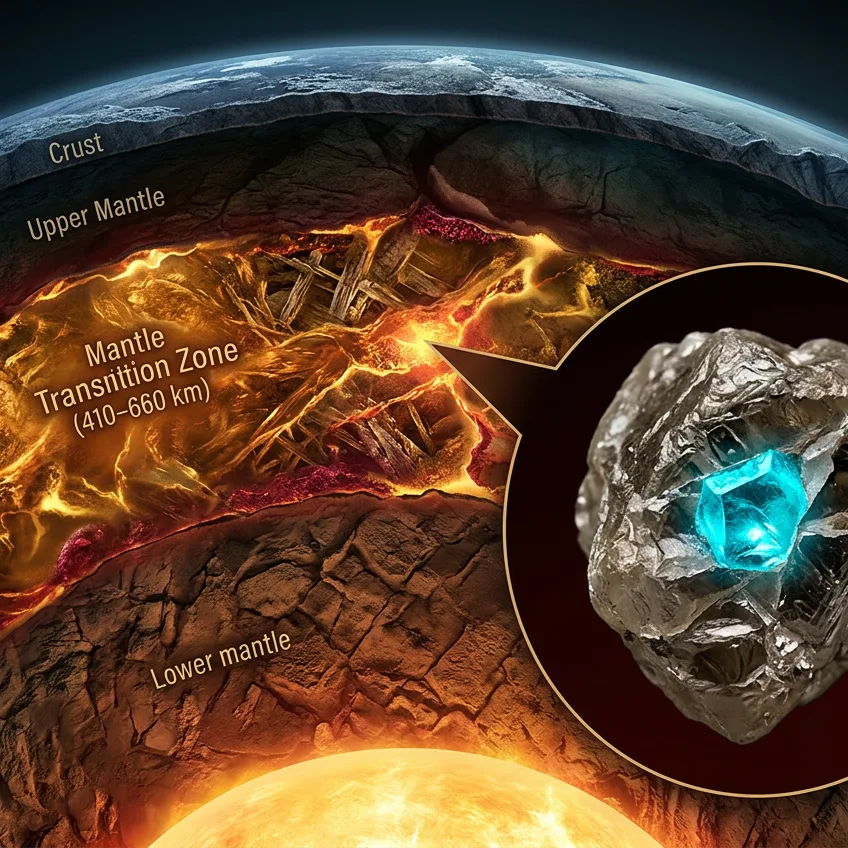
In 2014, an international team of geochemists led by Graham Pearson from the University of Alberta examined a modest 3-millimeter brown diamond mined in Juína (Mato Grosso, Brazil). Embedded inside, they discovered a speck invisible to the human eye: an inclusion measuring barely 40 micrometers of ringwoodite, an ultra-high-pressure mineral that had never been found in a terrestrial sample before.
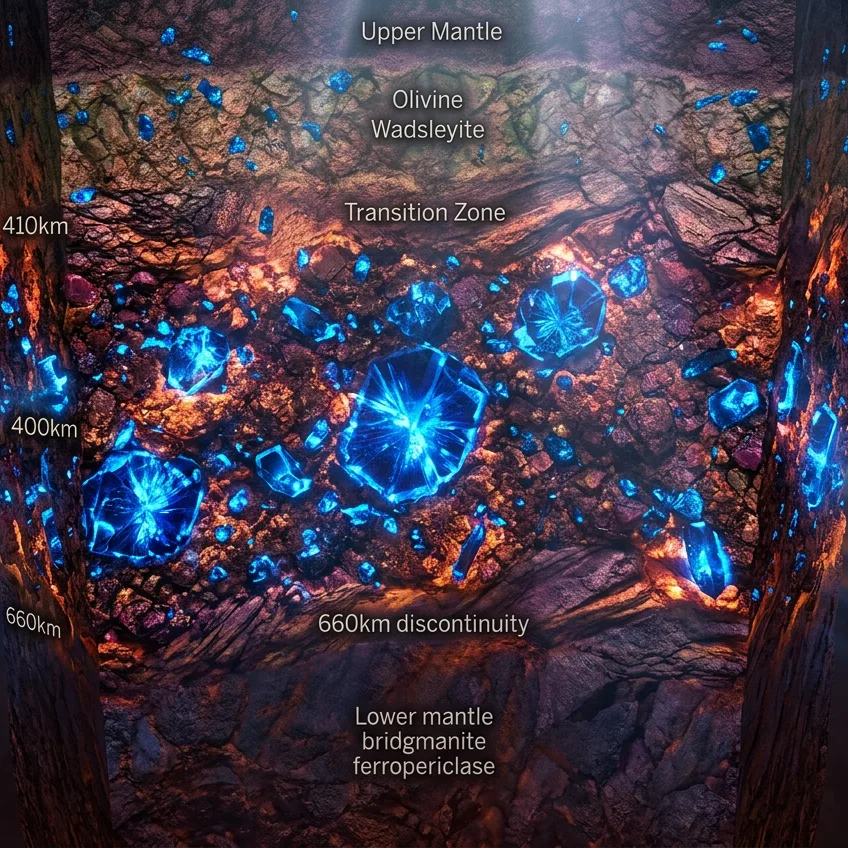
Ringwoodite is a high-density phase of olivine that only crystallizes under titanic pressures, between 410 and 660 kilometers deep, in what is known as the mantle transition zone. Although it was already known from meteorites fallen from space and laboratory recreations, this crystal was catapulted intact to the surface by an ultra-fast kimberlite volcanic eruption.
Infrared spectroscopy analysis yielded an astonishing result: the mineral contained approximately 1.5% water by weight, trapped molecularly as hydroxyl ions within its crystal lattice. While not liquid water in navigable caverns, this finding empirically proved that the transition zone is a colossal "mineral sponge."
Geophysical calculations indicate that if this layer is homogeneously hydrated, the deep mantle rocks hold a water mass equivalent to between one and three times the volume of all surface oceans combined. This hidden reservoir serves as a critical lubricant for mantle convection and plate tectonics that sustain life on the surface.
Source: Nature (Pearson et al., 2014 - 'Hydrous mantle transition zone indicated by ringwoodite included within diamond')