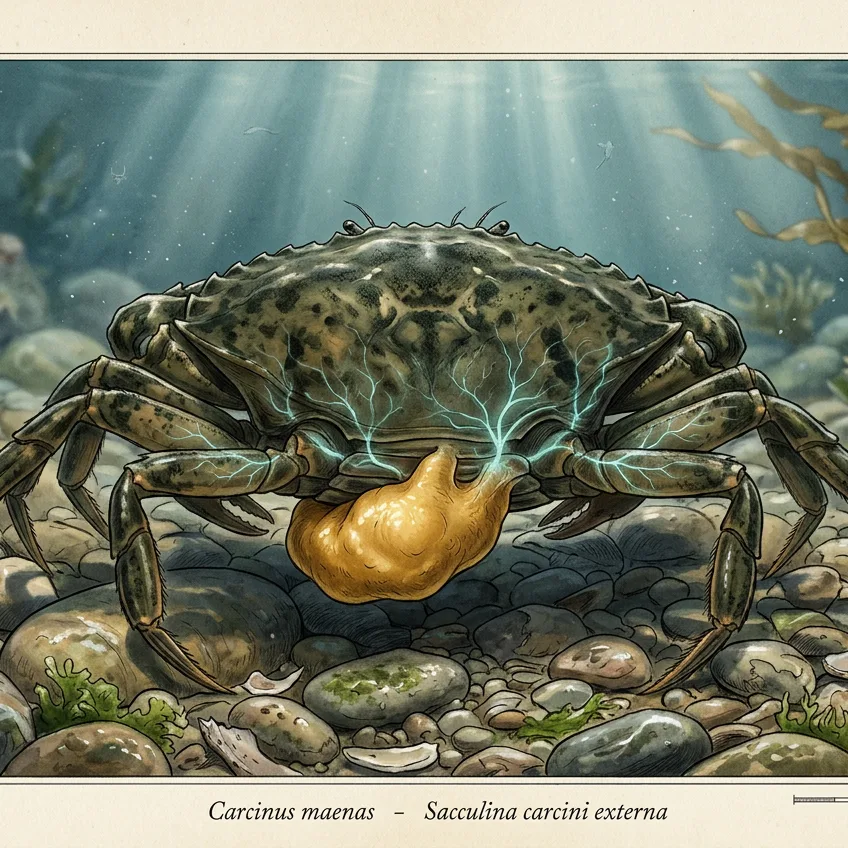
On Atlantic and Mediterranean coasts operates one of nature's most extreme cases of biological usurpation. Although it belongs to the cirripede crustacean group—direct relatives of barnacles and acorn barnacles—Sacculina carcini gives up any appearance of a crustacean to adopt a purely parasitic existence, capable of taking complete control over the physiology of its host, the shore crab (Carcinus maenas).
The process begins when a tiny female larva lands on the base of a crab's leg. After shedding its appendages and shell, it inserts a tubular structure similar to a hypodermic needle and injects a microscopic mass of cells into the crustacean's bloodstream. Once inside, the parasite does not form conventional organs, but rather a network of filamentous roots that invade the entire organism to silently absorb nutrients.
To ensure that its host devotes all of its energy to feeding it, Sacculina unleashes an astonishing hormonal and anatomical manipulation:
- Parasitic castration: It destroys the crab's gonads, preventing it from molting its shell or spending calories on its own reproduction.
- Forced feminization: If the host is a male crab, the parasite alters its hormone levels until it widens its abdomen and gives it the characteristic shape of a brooding female.
- Behavioral control: The parasite causes its reproductive sac to emerge from beneath the crab's abdomen; deceived by neurochemical signals, the male will clean, protect, and rock the invader's eggs in the water as if they were its own biological offspring.
Source: Nature / Journal of Experimental Biology (Studies on rhizocephalan parasitism and parasitic castration)