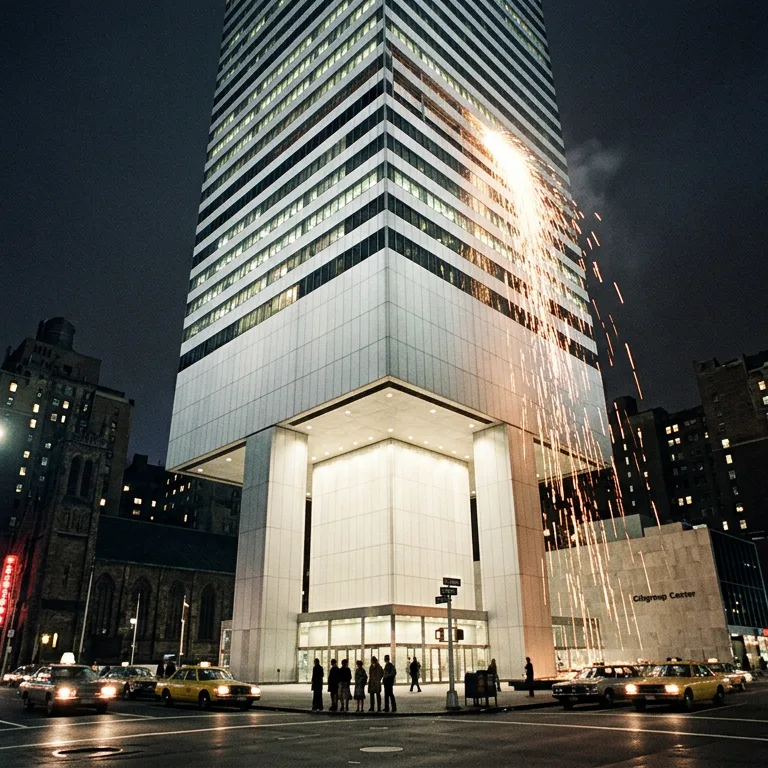
In 1977, the Citigroup Center (then Citicorp) opened in Manhattan, a 279-meter-tall, fifty-nine-story skyscraper with an unusual base: it was built on four massive stilts placed at the center of each facade instead of at the corners, all to preserve a preexisting Lutheran church on the site.
Months after its completion, a twenty-two-year-old engineering student named Diane Hartley calculated in her undergraduate thesis that quartering winds (those striking the corners at forty-five degrees) caused a 40% higher load on the chevron braces than anticipated. Upon reviewing Hartley's warnings, renowned structural engineer William LeMessurier discovered a terrifying additional fact: during construction, the contractor had replaced welded joints with bolted joints to cut costs and time.
The building was vulnerable to catastrophic collapse in a storm with winds of ninety kilometers per hour, an event occurring in New York every sixteen years. To prevent public panic, a clandestine emergency repair was organized:
- Crews of welders worked at night for two months, reinforcing over two hundred joints with five-centimeter thick steel plates.
- The New York Police Department and the Red Cross covertly developed an urgent evacuation plan for ten surrounding blocks.
- Hurricane Ella approached the East Coast in September 1978, brushing past the city just as the work was nearing completion.
The incident remained under complete corporate silence for nearly twenty years, until a journalistic investigation in 1995 revealed the daring night repairs that saved Manhattan.
Source: The New Yorker (Joe Morgenstern, 'The Fifty-Nine-Story Crisis', 1995) / ASCE