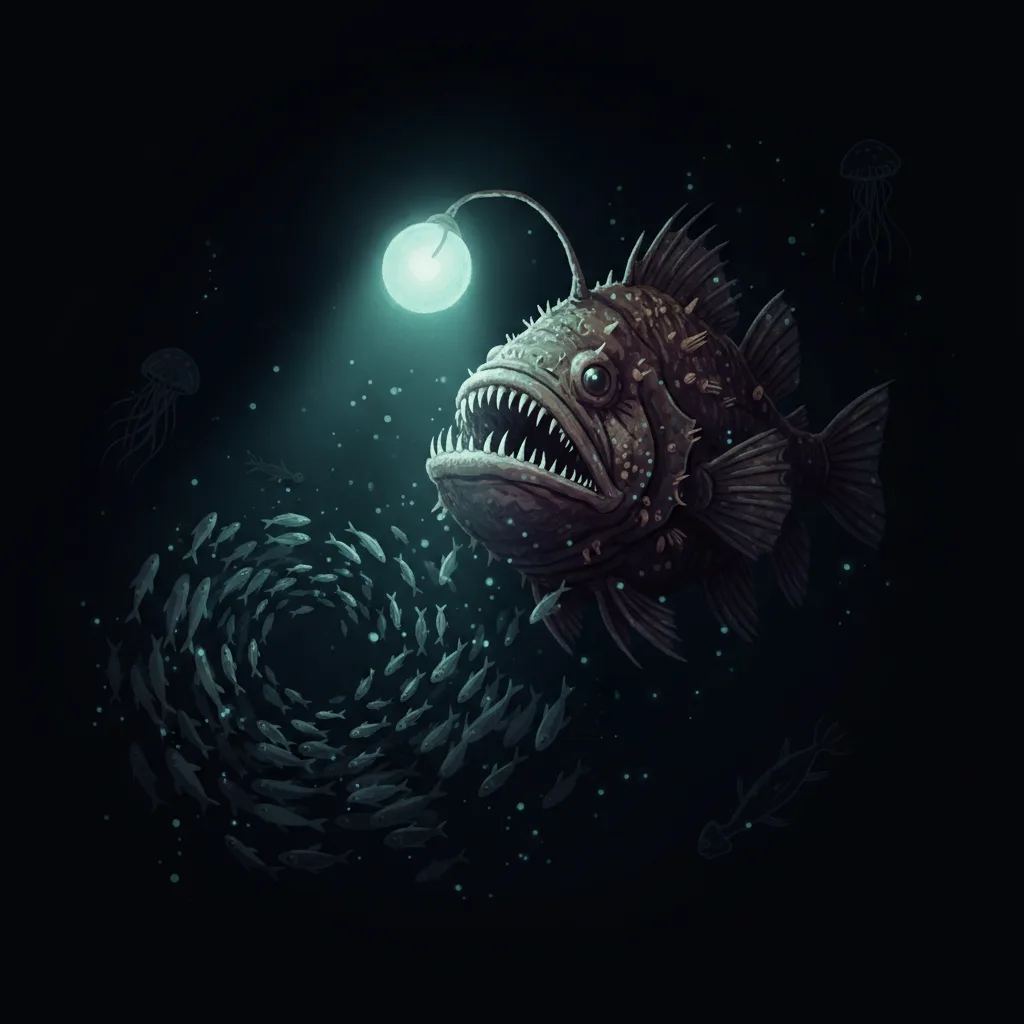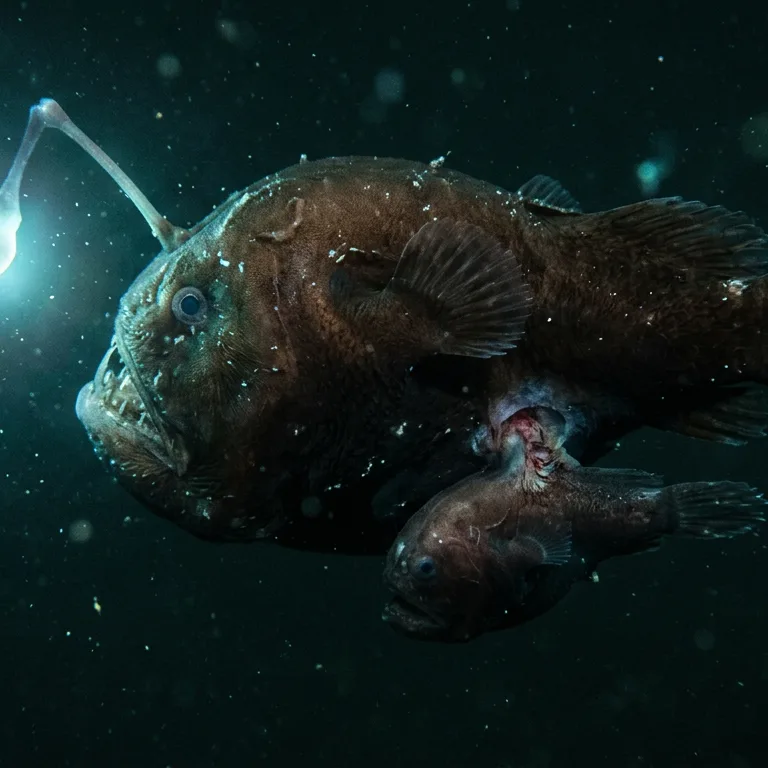
In the perpetual gloom of the deep sea, finding a mate is a colossal challenge. To solve it, fish of the Ceratioidei family (known as deep-sea anglerfish) developed one of nature's most extreme adaptations: permanent sexual parasitism through anatomical parabiosis.
When a tiny male—sometimes up to sixty times smaller than the female—tracks a mate's pheromones, he bites her belly and never lets go again. Over the days, he releases enzymes that dissolve the tissue of his own mouth and the female's skin. Their flesh heals together and their circulatory systems interconnect completely, allowing the male to feed directly on nutrients from her blood. Over time, the male's eyes, fins, and most internal organs atrophy until they disappear, essentially turning him into a living sperm reservoir ready to fertilize when the female spawns.
For decades, this fusion was an absolute immunological mystery: in any other vertebrate, joining tissues from two individuals would trigger fulminant rejection mediated by the major histocompatibility complex (MHC). However, a pioneering study published in Nature in 2020 by the Max Planck Institute revealed that these species evolutionarily lost key components of their adaptive immunity. They lack functional genes for T cells and hypermutated antibodies, having completely remodeled their innate immune system to avoid rejecting their mate's graft, a phenomenon that modern medicine studies to prevent organ rejection in humans.
Source: Swan, G. E., et al. (2020). 'The evolutionary loss of adaptive immunity in deep-sea anglerfishes'. Nature, 584(7821), 408-412.