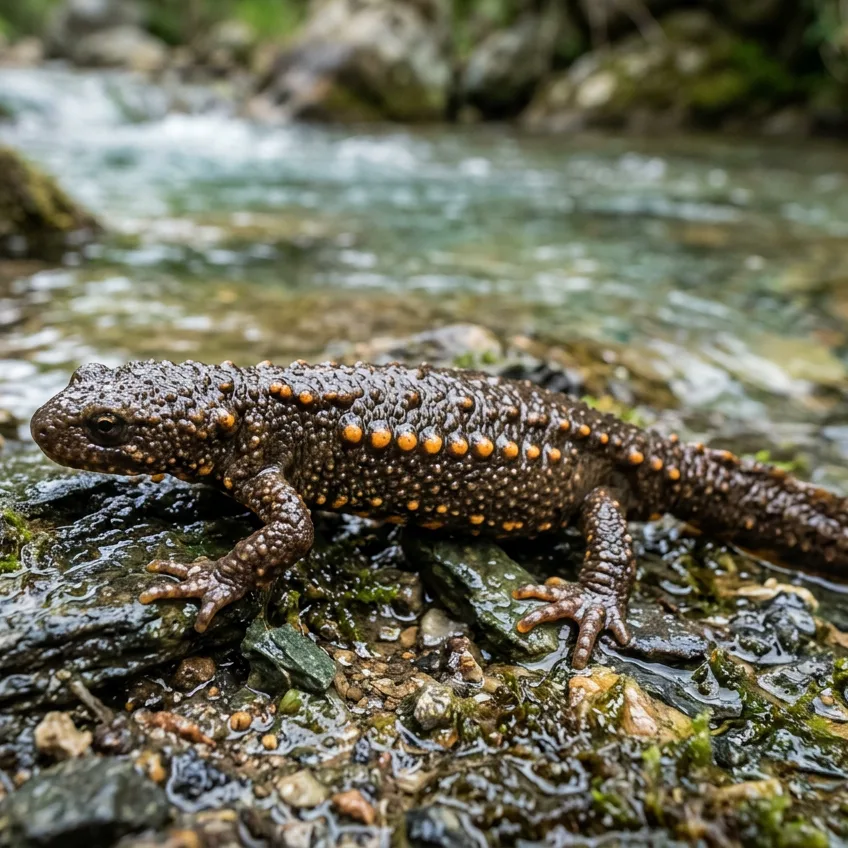
In the animal kingdom, defense mechanisms range from camouflage to poison, but the sharp-ribbed newt (Pleurodeles waltl), the largest urodele amphibian on the Iberian Peninsula, possesses one of the most extreme defensive strategies on the planet: it uses its own bones as external piercing weapons.
When a predator tries to swallow it, the sharp-ribbed newt arches its body and forcefully rotates its ribs forward. This mechanical pressure forces the sharp tips of its thoracic bones to pierce through its own dermis, poking out through a row of orange markings along its flanks. During the piercing process, the bone is instantly coated in a poisonous, irritating secretion produced by specialized skin glands, transforming each rib into a veritable hypodermic needle that pierces the attacker's palate.
The most astonishing aspect of this mechanism is not just the attack, but the sharp-ribbed newt's ability to emerge unscathed:
- Aseptic regeneration: Despite opening dozens of puncture wounds along its torso, the dermal tissue seals and fully regenerates within a few days without leaving scars or suffering bacterial infections.
- Specialized articulation: Its ribs are connected to the vertebrae by dual-axis joints that allow them to rotate up to 27 degrees outward without fracturing.
Described in biomechanical detail by researchers at the University of Vienna in 2010, this system makes the sharp-ribbed newt one of the very few vertebrates capable of deliberately injuring itself to ensure its survival.
Source: Journal of Zoology (Heiss et al., 2010: 'Armed newts: versatile use of ribs as weapons in the Spanish ribbed newt Pleurodeles waltl')