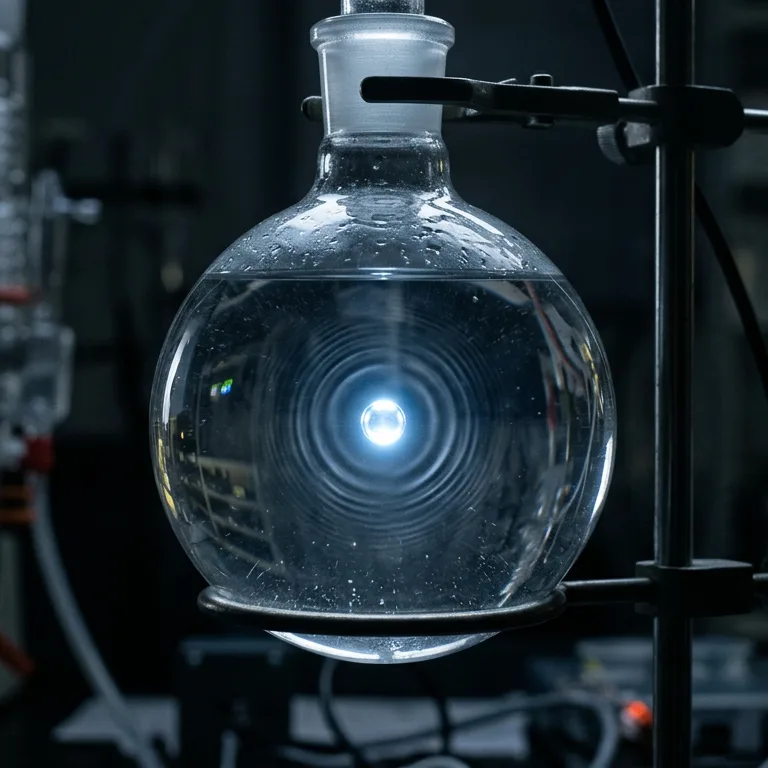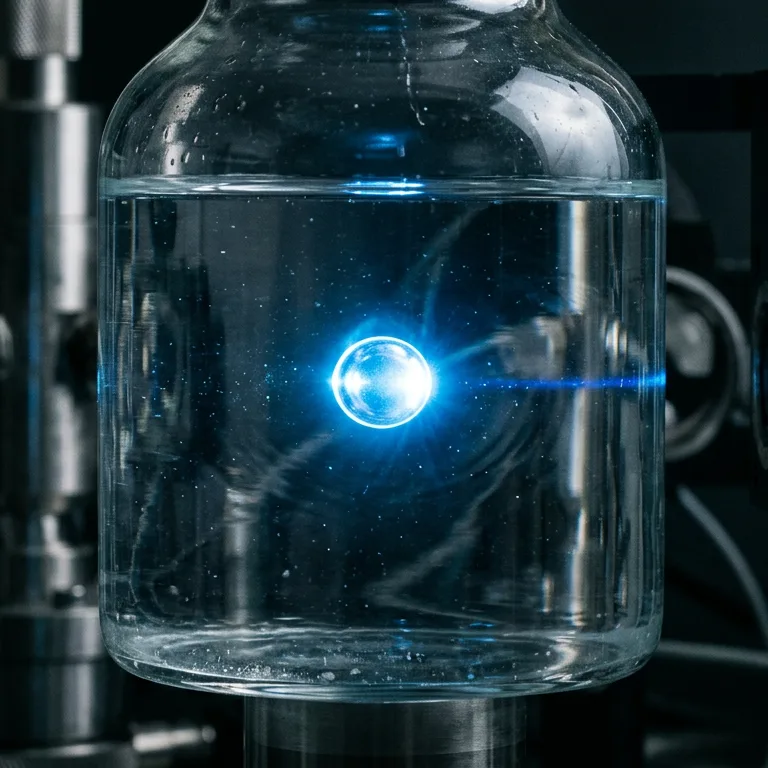
In 1934, German physicists H. Frenzel and H. Schultes made a puzzling discovery at the University of Cologne: when subjecting a photographic developing bath to intense underwater ultrasound, the plates fogged up in complete darkness. They had discovered sonoluminescence, a physical phenomenon in which sound is transformed directly into flashes of light.
The mechanism behind this astonishing process lies in acoustic cavitation. When a high-frequency sound wave travels through a liquid, it creates regions of low and high pressure:
- Expansion phase: During the acoustic depression, a microscopic gas bubble trapped in the fluid expands dramatically, reaching several times its original size.
- Catastrophic collapse: As the cycle shifts to high pressure, the inertia of the surrounding liquid crushes the bubble inward at supersonic speeds, 4 times faster than the speed of sound in gas.
- Thermal ignition: At the final moment of collapse, lasting barely a few tens of picoseconds, the interior gas undergoes adiabatic compression so brutal that its temperature surges to between 6,000 and 20,000 Kelvin, matching or exceeding the heat of the solar surface.
In 1989, physicist Felipe Gaitán managed to trap a single bubble at the node of an acoustic standing wave, causing it to pulsate and flash millions of times with clockwork precision comparable to atomic clocks. Although its core reaches a fiery plasma capable of ionizing noble gas atoms, the flash is so fleeting and localized at the nanometer scale that the surrounding water remains cool to the touch.
Source: Nature / Physical Review Letters (Gaitan et al., 1992)