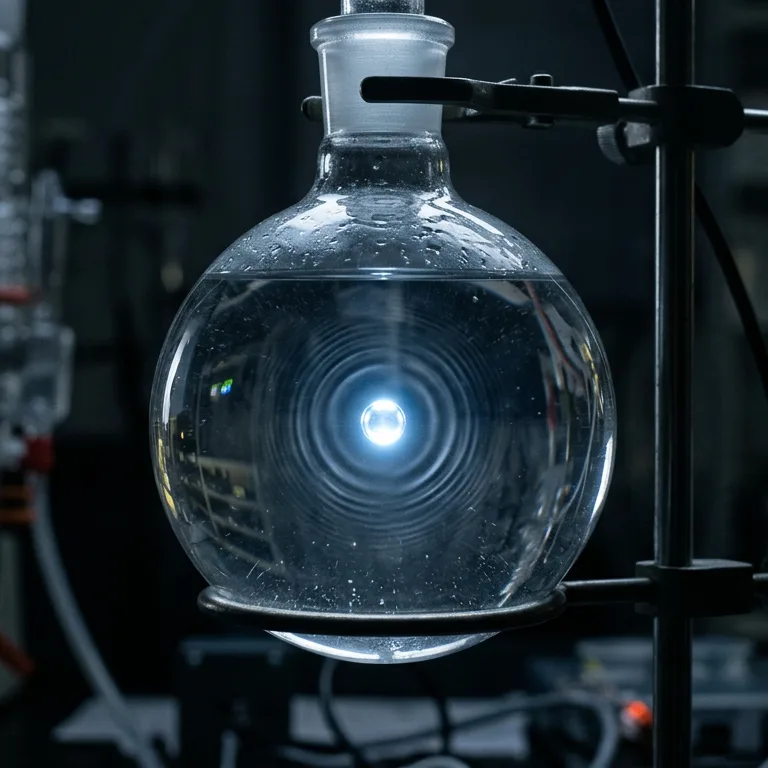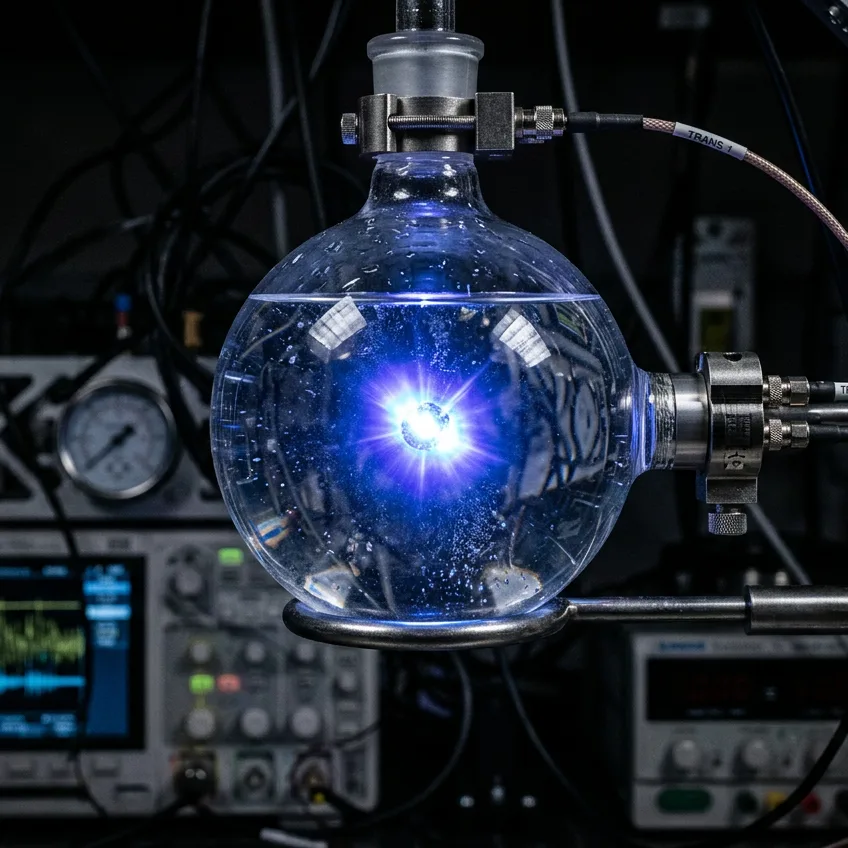
Is it possible to create visible light from sound waves? In 1934, German physicists H. Frenzel and H. Schultes accidentally discovered a baffling phenomenon: when subjecting water to intense ultrasound fields, tiny gas bubbles emitted flashes of light. This physical process, known as sonoluminescence, remained an unsolved curiosity for decades until 1989, when researchers managed to confine it within a single stable bubble using resonant acoustic waves.
The underlying mechanism illustrates one of the most extreme energy concentrations observed in an ordinary laboratory:
- Expansion and vacuum: A standing sound wave traps a gas microbubble at the center of a flask filled with liquid. During the low-pressure acoustic phase, the bubble expands to four times its radius.
- Supersonic collapse: As the acoustic pressure switches to its compression peak, the inertia of the surrounding liquid crushes the bubble toward its center at supersonic speeds relative to the speed of sound in the gas.
- Ionization and emission: The interior gas undergoes an adiabatic compression so instantaneous and severe that molecules break apart and atoms ionize, forming an incandescent microplasma.
At the peak of collapse, the bubble's interior reaches thermal peaks estimated between 15,000 and 20,000 Kelvin, a figure that easily triples the temperature of the Sun's visible surface (around 5,800 K). The result is a burst of bluish and ultraviolet light lasting barely 100 picoseconds, a true 'star in a test tube' generated exclusively by the power of sound.
Source: Nature / Physical Review Letters (Single-Bubble Sonoluminescence studies)