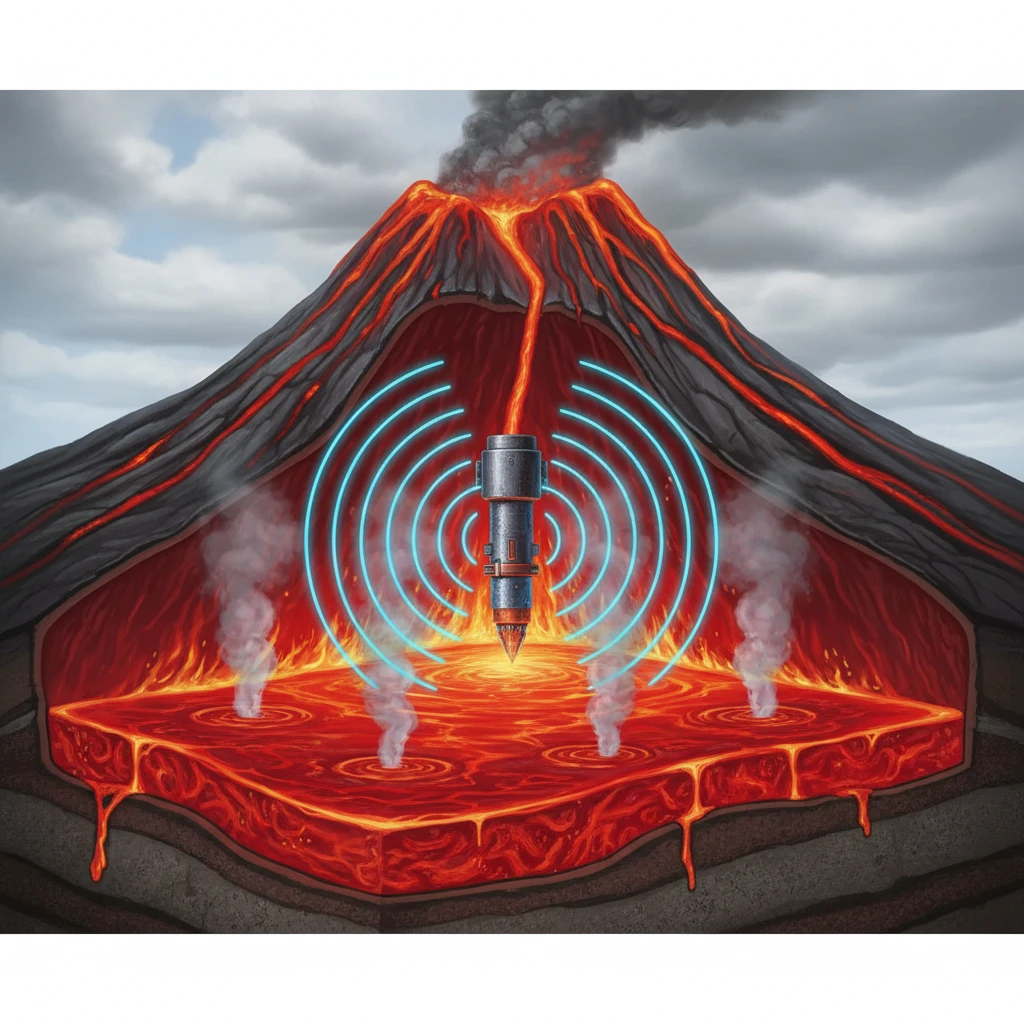
Scientists from the University of Cambridge have discovered that applying high-frequency ultrasound directly into molten magma can alter its viscosity and its ability to release gases, two key factors in the explosiveness of a volcanic eruption. In laboratory experiments simulating real magmatic conditions, they discovered that sound waves create tiny vapor bubbles that act as escape channels, reducing the pressure built up inside the volcano.
This technique, known as volcanic acoustics, could be used to create artificial 'safety valves' in active volcanoes such as Mount Etna or Mount Vesuvius. Researchers estimate that with just 48 hours of continuous ultrasound application, they could reduce the risk of explosive eruptions by 70%. The method is especially promising for volcanoes near urban areas, where a catastrophic eruption could affect millions of people.
- Optimal frequency: 20-40 kHz (ultrasound audible only to certain animals)
- Effective depth: Up to 5 km below the volcanic surface
- Required energy: Equivalent to that of 500 household appliances running simultaneously
The next step is to develop robust probes capable of withstanding extreme volcanic conditions for on-site testing. If successful, this technology could save lives and prevent natural disasters on a historical scale.
Source: Study published in 'Nature Geoscience' by researchers from the University of Cambridge (2023). Laboratory experiments with simulated magmas from Mount Etna.