At sea level, water freezes at zero degrees Celsius and boils at one hundred. However, under extreme conditions of pressure and heat, the physics of water defies all intuition. In 2018, physicists at Lawrence Livermore National Laboratory succeeded in synthesizing superionic ice (known as ice XVIII) for the first time, an exotic phase of matter that is neither completely solid nor liquid, but both at once.
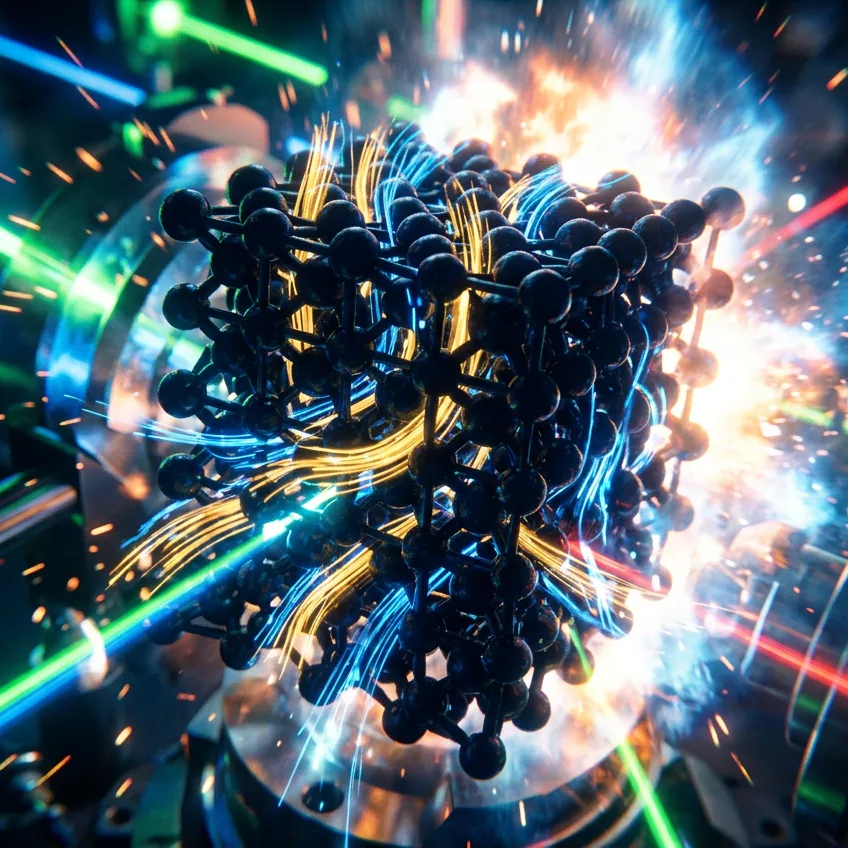
To create it, scientists trapped a tiny water droplet between two diamond anvils and fired gigantic laser bursts that generated shock waves with pressures of up to four million atmospheres and temperatures near five thousand degrees Celsius. What happened lasted barely nanoseconds, but it was enough to confirm a theoretical prediction decades in the making:
- Dual structure: Oxygen atoms freeze into a rigid, compact crystal lattice, behaving as a true solid.
- Protonic fluid: Hydrogen atoms break free from their molecular bonds and their nuclei (protons) flow freely through the voids of the oxygen lattice, behaving like a liquid.
- Metallic conductivity: Due to the flood of moving free protons, this ice is neither transparent nor an insulator; it turns black and conducts electricity almost as efficiently as a metal.
This finding is not just a laboratory feat. Astrophysicists estimate that massive mantles of superionic ice make up the interiors of ice giants such as Uranus and Neptune, acting as the direct source responsible for their chaotic, asymmetric magnetic fields.
Source: Nature (Experimental evidence for superionic ice, Millot et al., 2018 / 2019)