For decades, science considered spider dragline silk to be nature's strongest biological material. However, a landmark 2015 study published by engineers from the University of Portsmouth revealed that the absolute record belongs to a modest coastal mollusk: the common limpet (Patella vulgata).
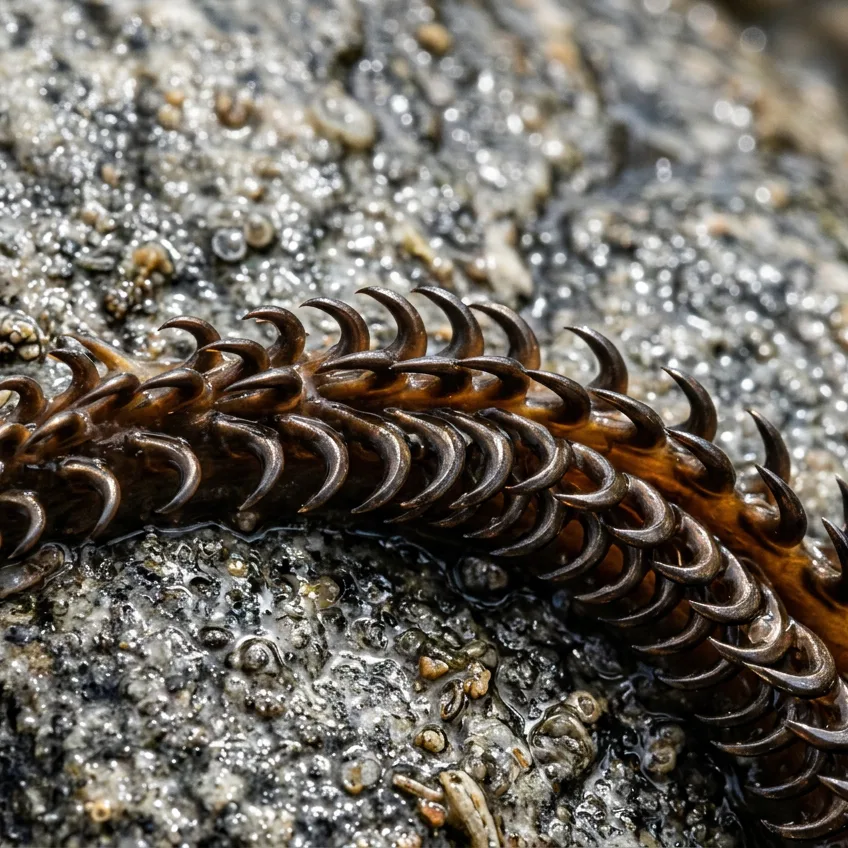
To feed, this gastropod tirelessly scrapes microscopic algae encrusted on granite or basalt rocks using its radula, a tongue armed with hundreds of rows of curved teeth barely one millimeter in length. To avoid losing its teeth in the process, evolution endowed these teeth with an astonishing tensile strength, ranging between 3.0 and 6.5 gigapascals (GPa). This figure not only shatters the strength of spider silk, but also rivals high-performance industrial carbon fibers and far surpasses Kevlar and structural steel.
The secret of this indestructible strength lies in its nanoscale architecture:
- Goethite nanofibers: An extremely hard iron oxide mineral distributed in fibers thousands of times thinner than a human hair.
- Elastic chitin matrix: A flexible polymer that absorbs impacts and prevents microscopic cracks from propagating through the tooth.
The most extraordinary finding under atomic force microscopy is that, unlike man-made materials that weaken as their size increases, the microscopic structure of limpet teeth retains the exact same colossal strength regardless of scale, a biomimetic principle that now inspires the design of new ballistic armor and ultralight aerospace fuselages.
Source: Royal Society Interface (University of Portsmouth, 2015 - 'Extreme strength observed in limpet teeth')