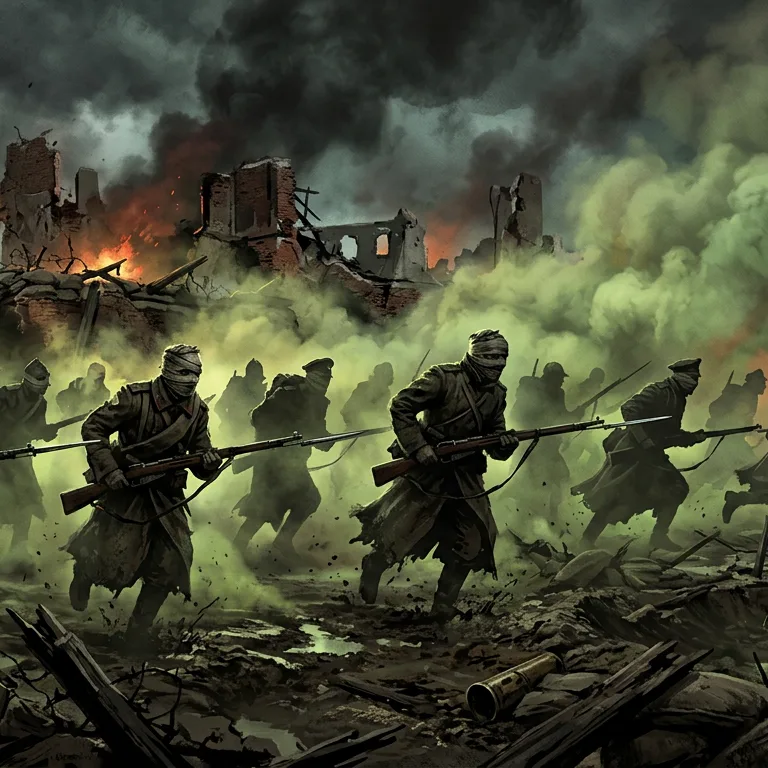
On August 6, 1915, during World War I, the German army was preparing to definitively capture the Osowiec Fortress (in present-day Poland). After months of unsuccessful siege, German commanders deployed more than thirty batteries of toxic gas, releasing a dense cloud of chlorine and bromine that advanced inexorably toward the Russian defensive positions, which lacked adequate gas masks.
The chemical mixture reacted with the moisture in the soldiers' mucous membranes, generating hydrochloric acid in their airways. The cloud withered the grass, turned the leaves yellow, and killed livestock for kilometers around. Believing not a single soul remained alive, more than seven thousand German infantrymen advanced with confidence to occupy the position. However, they witnessed a scene straight out of a nightmare.
From the poisoned trenches emerged a spectral force: about sixty survivors of the Russian 13th Battalion, led by Sub-Lieutenant Vladimir Kotlinsky. With their faces wrapped in bloodied rags, their eyes wild, and coughing up pieces of their own lungs corroded by the acid, the soldiers fixed their bayonets and charged at a run toward the enemy.
The psychological horror of seeing dying men charge with blind fury unleashed absolute chaos in the invading ranks. The Germans retreated in a rout with such hysteria that many fell and became trapped in their own barbed-wire traps, allowing the defenders to secure the fortress temporarily.
Source: Kauffman, J. E., & Kauffman, H. W. (2016). *Verdun 1916: The Renaissance of the Fortress*. Pen & Sword Military.