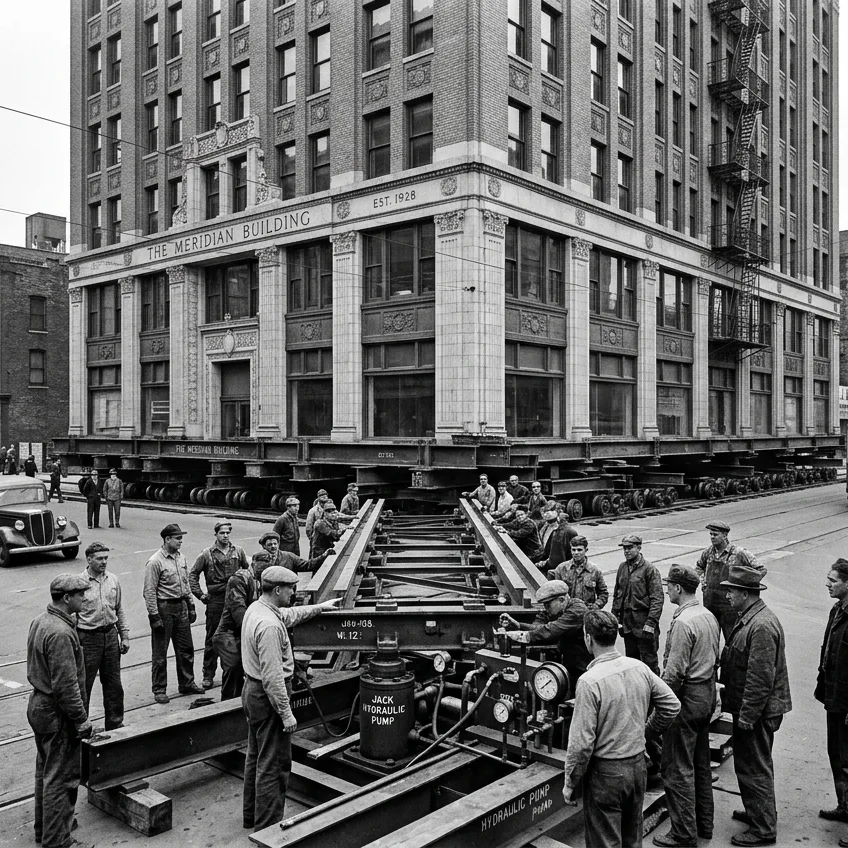
In October 1930, the Indiana Bell telephone company faced an urban dilemma in Indianapolis: they needed to expand their corporate headquarters, but demolishing the eight-story brick and steel building would have interrupted communications service for the entire city. The chosen solution defied all logic: moving the entire 11,000-ton building to an adjacent lot without stopping the work of the 600 employees operating inside.
The work, directed by engineer Leslie Horn, used a colossal technique. First, workers excavated the foundations and shored up the structure on main beams resting on hundreds of hardened steel rollers. With millimeter precision, a human team operated hydraulic and mechanical jacks that pushed the building at an average speed of 40 centimeters per hour:
- The route: The colossus moved 16 meters south, rotated exactly 90 degrees on its axis, and traveled another 30 meters west.
- Uninterrupted services: To avoid cutting off water, gas, electricity, or sewer lines, high-resistance flexible rubber connections were installed.
- Live cables: Thousands of active telephone lines were spliced into articulated flexible hoses.
To further astonishment, workers entered and left their jobs every day across a movable pedestrian walkway connected to the entrance. Over the 34 days that the maneuver lasted, not a single call was dropped, no glass broke, and employees claimed the movement was so smooth that coffee did not even shake on their desks.
Source: Historic Indianapolis / American Society of Civil Engineers (ASCE)