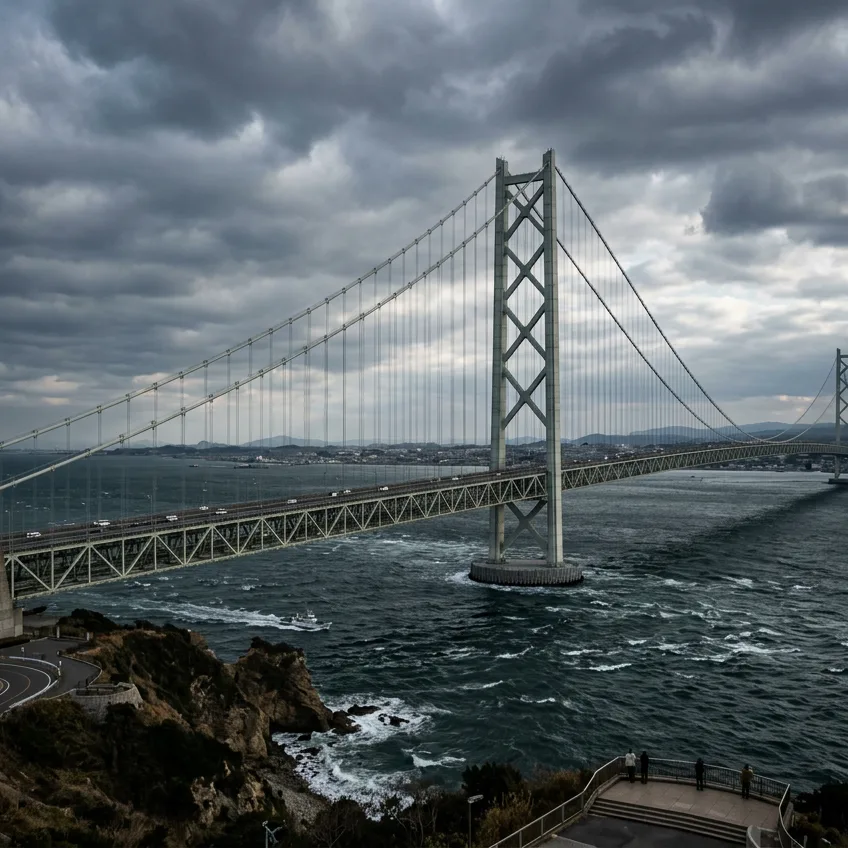
On January 17, 1995, the devastating Kobe earthquake struck Japan with a magnitude of 6.9. In the middle of the Akashi Strait, right above an active tectonic fault, one of the greatest civil engineering feats in history was being built: the Akashi Kaikyo Bridge. At that time, the two colossal 298-meter-tall steel towers and the concrete anchorages were already fixed to the seabed, but the main cables had not yet been strung.
The violent geological movement shifted the seafloor. When the aftershocks ceased, the engineers discovered in astonishment that the seismic-resistant design of the towers had worked perfectly: they had suffered no structural damage. However, the ground had completely deformed. The submarine Nojima Fault had fractured, pushing the south tower and moving it nearly 1 meter (exactly 80 centimeters) away from the north tower.
Far from abandoning the project, the engineering team made an unusual decision:
- Complete recalculation of the cables: The manufacturing length of the 1.12-meter-diameter steel cables was immediately adjusted.
- Expansion of the span: The steel truss deck was redesigned to add an extra meter to the central span, changing from the planned 1,990 meters to a final 1,991 meters.
Inaugurated in 1998 with an overall length of 3,911 meters, the Akashi Kaikyo colossus proved that modern engineering can not only anticipate the impact of the worst natural disasters, but also adapt to a shifting Earth's crust.
Source: Honshu-Shikoku Bridge Expressway Company / American Society of Civil Engineers (ASCE)