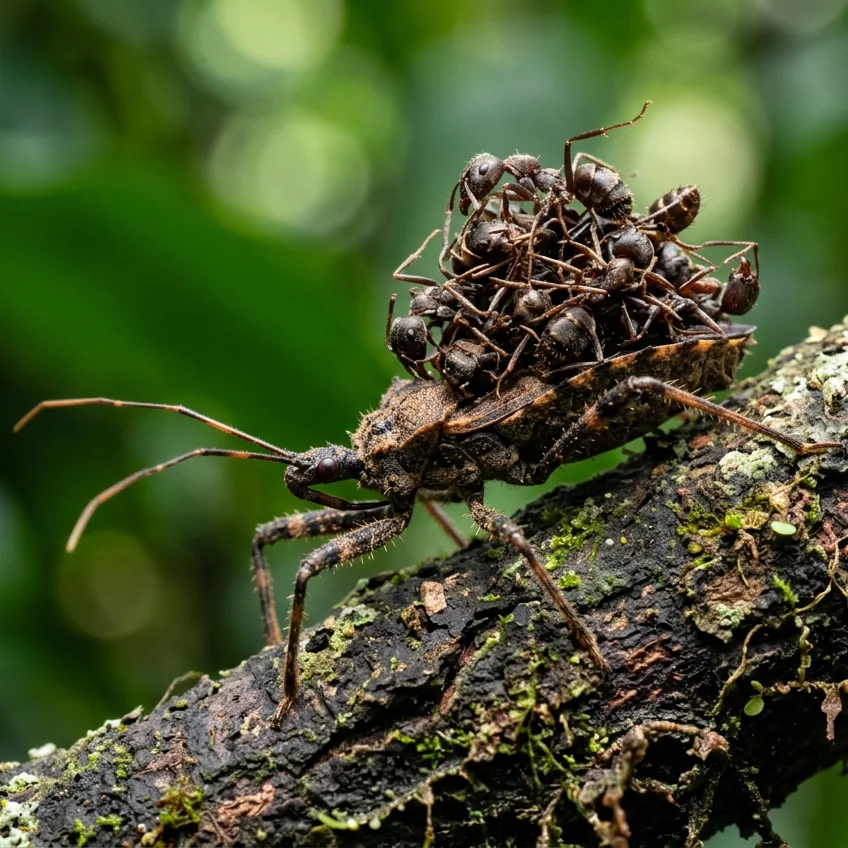
In the fascinating realm of animal camouflage, few organisms have developed a tactic as macabre and sophisticated as Acanthaspis petax, a species of assassin bug (family Reduviidae) found in regions of Africa and Southeast Asia. After ambushing an ant, paralyzing it with enzymatic saliva, and sucking out its internal fluids, this predator does not discard the hollow shell: it carefully fastens it to its back using sticky glandular secretions.
As it hunts, the nymph can amass bulky armor made of more than twenty ant exoskeletons, creating a mound that can double or triple the volume of its own body. For a long time, it was assumed that this burden simply served to conceal it from future prey. However, research from the University of Canterbury showed that it functions as an advanced decoy shield against its natural predators: jumping spiders (salticids).
Jumping spiders are primarily visual hunters with complex cognitive processing. When encountering Acanthaspis petax, the spider's visual system does not identify the outline of a solitary bug, but rather a chaotic tangle of ants—creatures that spiders usually avoid due to their group aggression and formic acid secretions. Moreover, if the spider ventures to jump, it often strikes the outer mass of corpses, allowing the bug to escape unharmed or counterattack with its lethal proboscis.
Source: Journal of Experimental Biology / Proceedings of the Royal Society B (Studies on Acanthaspis petax and aggressive mimicry)