At depths between 600 and 800 meters, in the perpetual twilight of the northern Pacific Ocean, lives one of the most unusual vertebrates on the planet: the Pacific barreleye (Macropinna microstoma). First described in 1939, this species baffled the scientific community for nearly seven decades, as specimens caught in trawl nets reached the surface decayed and with their delicate cranial structures destroyed by decompression.
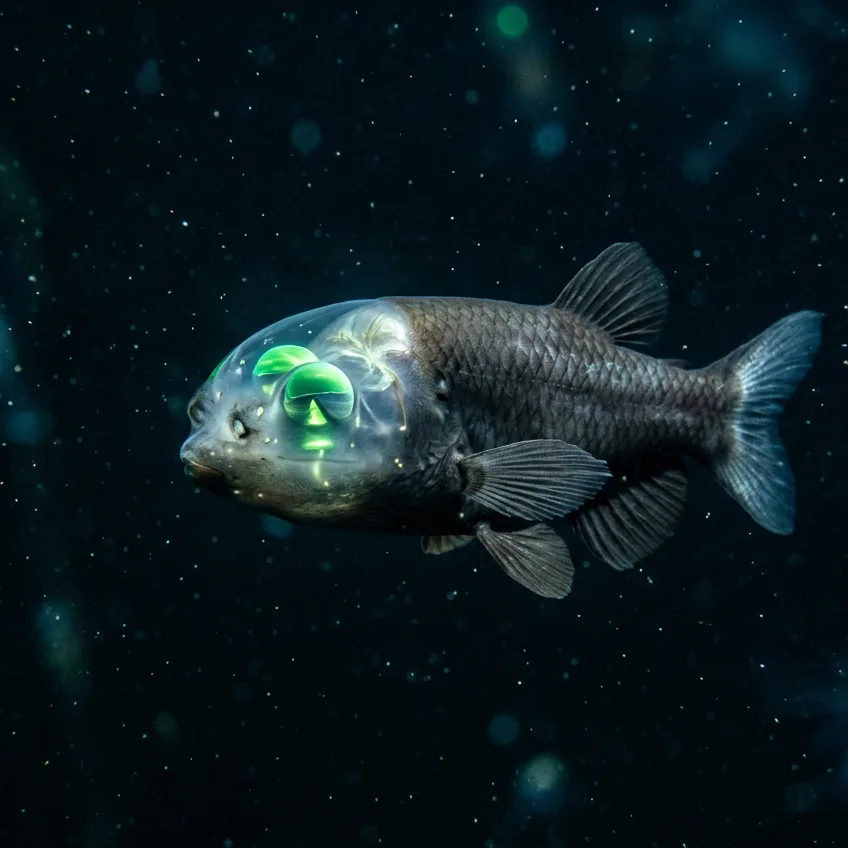
It was not until 2004 that biologists from the Monterey Bay Aquarium Research Institute (MBARI) managed to film it alive in its natural environment using remotely operated underwater vehicles. It was then that they discovered its astonishing anatomy: the entire upper part of its head is covered by a completely transparent tissue dome filled with a clear fluid that protects its visual organs from the stinging tentacles of jellyfish.
What appear at first glance to be two eyes on the front of its face are actually its nares (olfactory holes equivalent to nostrils). Its true eyes are two tubular spheres of an intense emerald green located inside its translucent skull. These lenses feature photosensitive pigments capable of filtering the scarce sunlight penetrating from the surface and highlighting the faint bioluminescence of its prey.
The most extraordinary feature of this vision is its mobility: thanks to a specialized muscular system, the fish can rotate its eyes 90 degrees, shifting from looking vertically upward while stalking shadows to directing them straight forward when approaching to capture its food with a tiny, extremely precise mouth.
Source: Monterey Bay Aquarium Research Institute (MBARI)