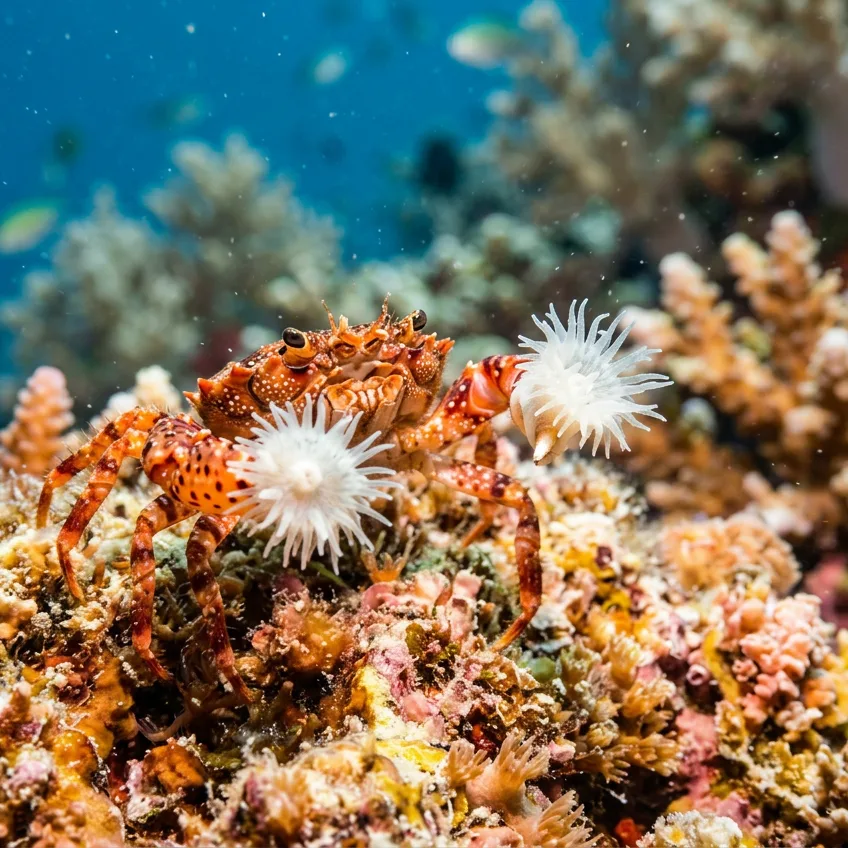
In the coral reefs of the Indo-Pacific lives an unusual creature measuring barely two and a half centimeters: the boxer crab (Lybia tessellata), also nicknamed the pom-pom crab. Unlike other crustaceans that rely on robust claws to crush or defend themselves, this animal has transformed its pincers into delicate clamps designed with a single purpose: to firmly hold small, living sea anemones, generally from the genus Triactis.
The association between both organisms goes far beyond simple coexistence:
- Deterrent biological weapons: Faced with any threat or curious predator, the crab thrusts the anemones forward, mimicking a boxer's guard. The anemones' tentacles are loaded with nematocysts, microscopic stinging cells that inject toxins and cause an intense, deterrent sting.
- Feeding mop: In addition to defense, the crab uses the sticky tentacles of its partners to sweep the sandy bottom and gather food particles, later sharing part of the spoils with the anemones themselves.
- Forced cloning: A study published in 2017 by Bar-Ilan University revealed unprecedented behavior: if a crab loses one of its two anemones, it carefully cuts the remaining one in half with an exact sagittal slice. Far from dying, both halves regenerate tissue in a matter of days, becoming two complete, functional cloned anemones.
This unusual mechanism makes the boxer crab one of the very few invertebrates capable not only of using living biological tools, but also of forcing asexual reproduction in another species to keep its arsenal consistently balanced.
Source: PeerJ (2017) - 'Strict acquaintance: mutualism and tool use in the boxer crab Lybia leptochelis'