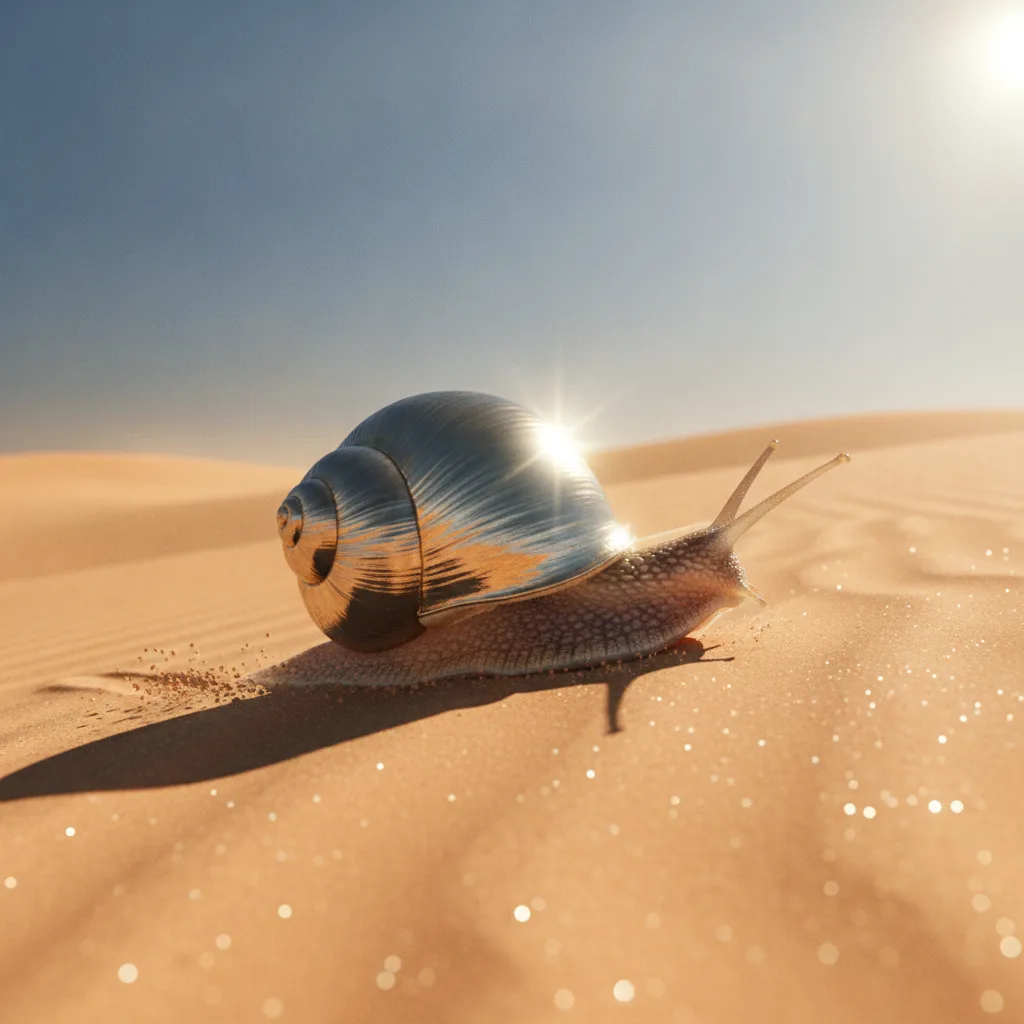
While most snails seek moisture and shade, Vitularia reflecta has made the sand deserts of Namibia and the Sahara its home. This small mollusk, commonly known as the dune snail, has evolved an astonishing series of adaptations to survive temperatures exceeding 60°C on the sand surface.
Its most notable feature is its iridescent and metallic shell, which acts like a mirror. This covering reflects up to 95% of incident solar radiation, preventing the animal's body from overheating to lethal levels. In addition, the shell is equipped with a thin insulating layer that retains body moisture.
However, its strategy is not merely passive. When the heat becomes unbearable, Vitularia performs a maneuver that seems straight out of a video game: it quickly buries its shell in the surface sand with rotary movements, descending to layers where the temperature is 20°C cooler. There, it can enter a state of estivation (similar to hibernation, but for heat) for months, waiting for the arrival of the cool Atlantic coastal fog.
When the fog arrives, the snail emerges and, to move across the hot dunes without burning, it has perfected a "sand surfing" technique. It glides over the superficial layer of fine, extremely hot sand, using a layer of refractory mucus that allows it to glide over the particles, covering distances of up to 10 meters per hour in search of dried vegetation and lichens.
Source: Journal of Arid Environments, Study: 'Thermoregulation in the dune-dwelling snail Vitularia reflecta' (2022).