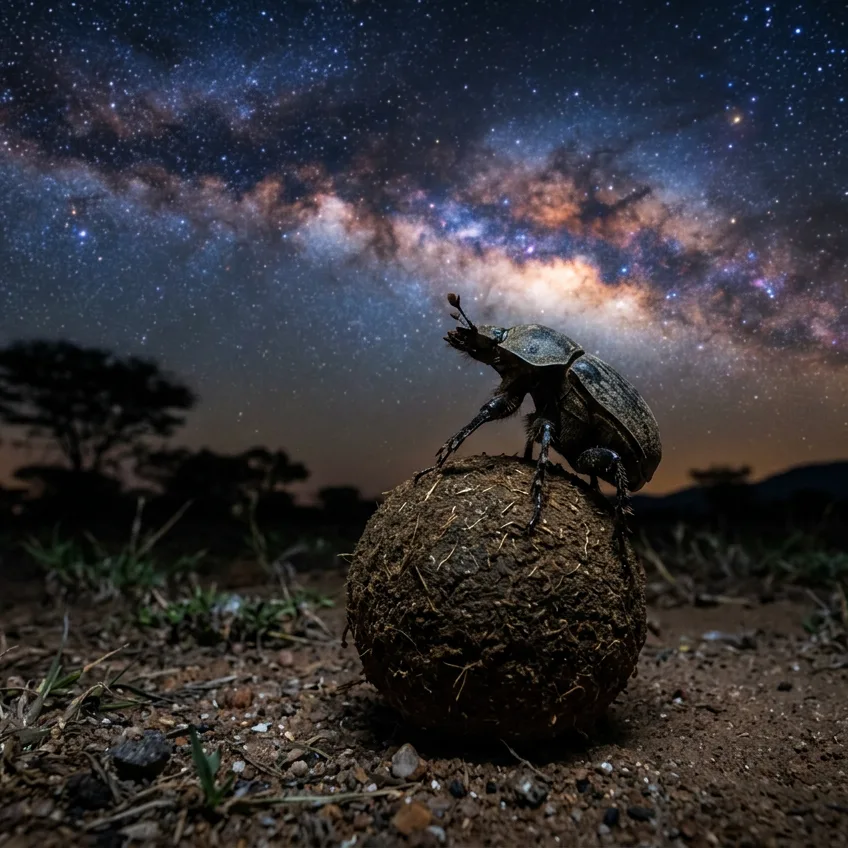
Rolling a dung ball in a straight line is a matter of life or death for the African dung beetle (Scarabaeus satyrus and Scarabaeus lamarcki). In the savanna, dozens of competitors wait to steal the freshly molded prize. Therefore, these beetles must move away from the main pile as quickly and straight as possible to bury their food. During the day, they use the position of the Sun, but for decades it remained a puzzle how they managed to maintain flawless paths on pitch-black, moonless nights.
In 2013, an international team led by biologist Marie Dacke solved the mystery through an ingenious experiment. The researchers fitted the beetles with tiny cardboard caps to block their view of the sky and placed them inside the Johannesburg planetarium. By projecting different celestial configurations, they discovered something extraordinary: the insects ignored the brightest individual stars, but when the diffuse band of the Milky Way was projected, they traced perfect straight lines without veering a single degree.
This discovery made the dung beetle the first animal on Earth confirmed to use the glow of an entire galaxy for orientation. Their compound eyes lack the optical sharpness needed to distinguish individual stars, but they are exceptionally sensitive to light contrast differences. By detecting the milky stripe that splits the night sky, the insect possesses an unalterable cosmic compass that prevents it from walking in circles and losing its meal in the dark.
Source: Current Biology (Dacke et al., 2013: 'Dung Beetles Use the Milky Way for Orientation')