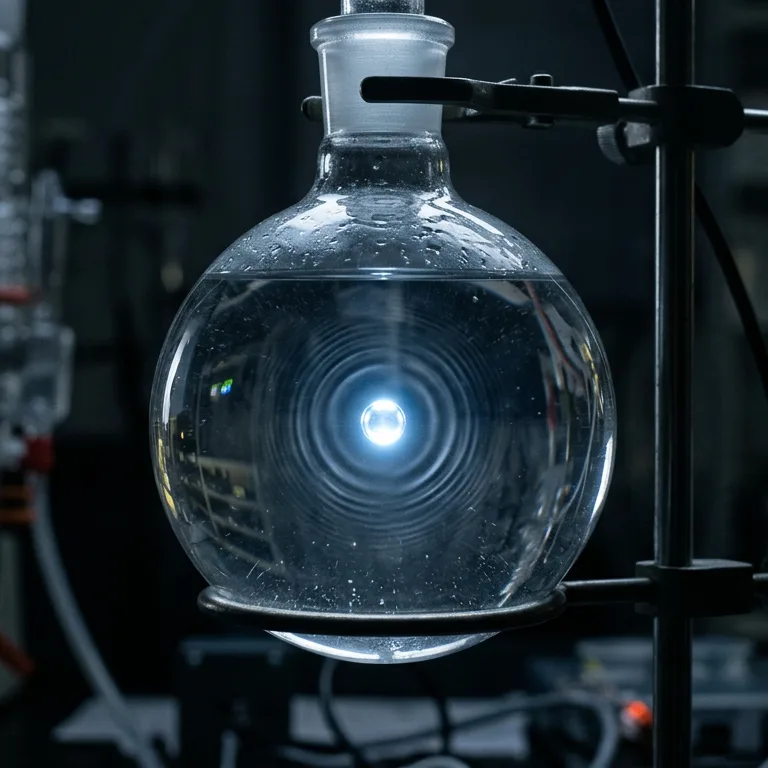
In classical physics, an absolute vacuum represents the total absence of matter and energy. However, in quantum mechanics, nothingness does not exist: empty space is an ocean in perpetual turmoil governed by quantum fluctuations, where pairs of virtual particles and antiparticles spontaneously emerge from the fabric of spacetime, only to annihilate each other in tiny fractions of a second.
In 1970, physicist Gerald Moore formulated a bold hypothesis: if a perfect mirror were to move through a vacuum at a speed close to that of light, the moving boundary would prevent these virtual pairs from recombining in time, separating them and transmuting them into real, detectable photons. This theoretical phenomenon was named the dynamical Casimir effect.
For four decades, it seemed an impossible experiment, since accelerating a physical object to relativistic speeds without disintegrating it defied the limits of engineering. The feat was finally achieved in 2011 by researchers from Chalmers University of Technology, in Sweden:
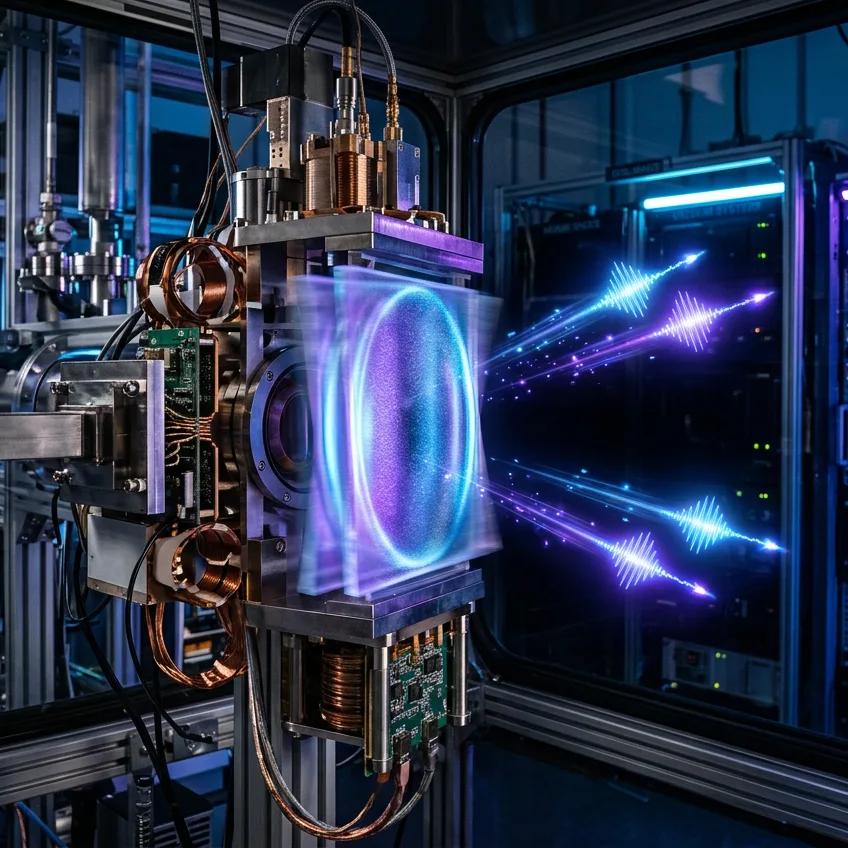
- The virtual mirror: Instead of moving a physical glass mirror, they used a SQUID (superconducting quantum interference device) capable of altering its electromagnetic inductance.
- Extreme speed: By modulating magnetic fields billions of times per second, they simulated a reflective wall vibrating at 5% of the speed of light (more than 15,000 km/s).
The detector recorded a net flux of electromagnetic radiation in the form of pairs of entangled microwaves born directly from vacuum perturbations. That milestone confirmed that the quantum vacuum is not inert, but a dynamic reservoir of latent energy from which it is possible to extract visible and measurable light.
Source: Nature (Wilson et al., 2011: 'Observation of the dynamical Casimir effect in a superconducting circuit')