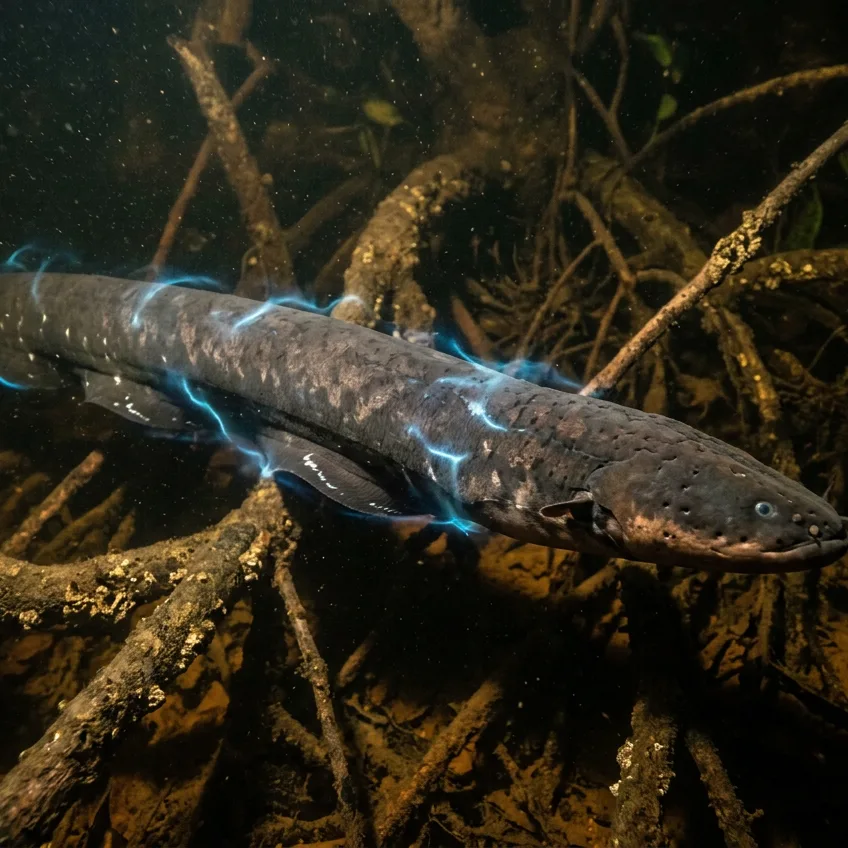
For more than two centuries, science considered the electric eel a blunt weapon of nature: an animal capable of releasing massive shocks to stun any nearby creature. However, research led by neurobiologist Kenneth Catania showed that its strategy is a sophisticated exercise in applied neurobiology.
The electric eel (especially the species Electrophorus voltai, capable of registering a biological record of 860 volts) uses its electricity as a remote control system. When prey remains hidden among river vegetation, the eel emits high-voltage double pulses. These signals are not meant to knock it out, but rather to act directly on the hidden fish's motor neurons, causing an involuntary muscle spasm. The resulting vibration immediately gives away the victim's exact position.
Once located, the final attack is swift: a continuous high-frequency volley that hijacks the prey's peripheral system. In less than three milliseconds, the discharge overloads muscle receptors, causing absolute tetanic paralysis and preventing the animal's heart or fins from responding.
This wonder is possible thanks to thousands of electrocytes—modified muscle cells lacking contractile ability—stacked in series across three specialized organs (the Main organ, Hunter's organ, and Sachs' organ). Together, they function as a giant biological battery that turns fresh water into a theater of instant neurological dominance.
Source: Vanderbilt University / Nature Communications (Kenneth Catania, 'The shocking predatory strike of the electric eel')