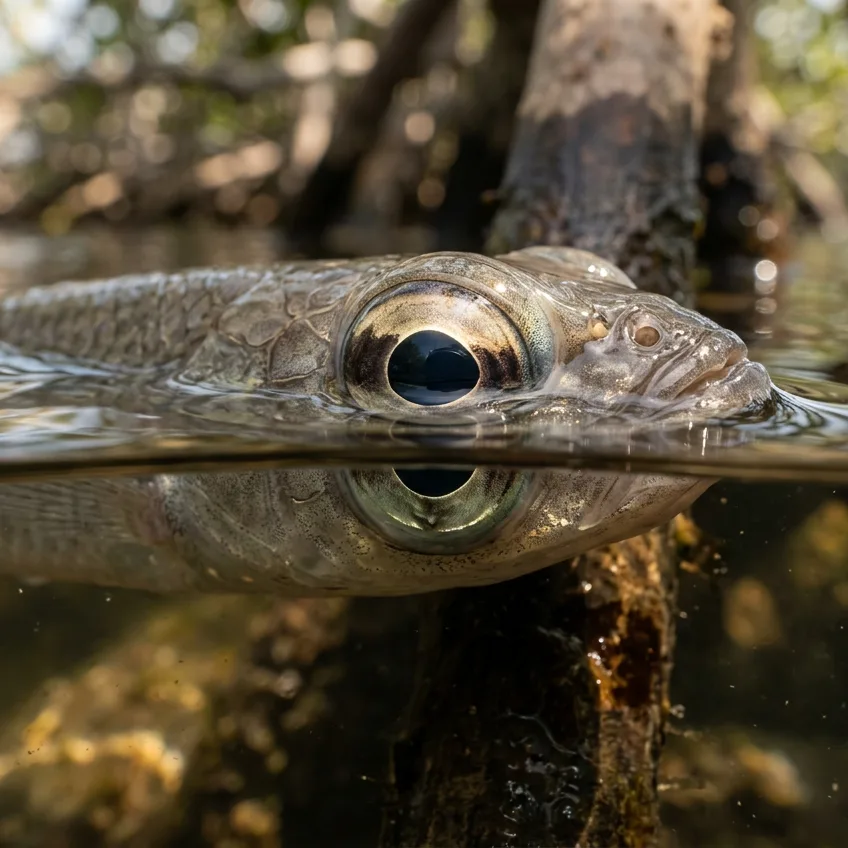
Swimming at the water's surface presents an insurmountable optical dilemma for almost any vertebrate: light behaves radically differently in air than in water. Aquatic refraction distorts the vision of an eye adapted to the atmosphere and vice versa. However, in the mangroves of Central and South America lives an evolutionary specialist that solved this conflict: the four-eyed fish (Anableps anableps).
Although anatomically it has only two eyeballs, each of them is horizontally divided by a band of pigmented epithelial tissue, giving it two functional pupils per eye. The fish's waterline rests with millimeter precision on this boundary, so that the upper half of the eye projects into the open air while the lower half remains submerged.
The real biophysical marvel lies within:
- Asymmetric lens: Instead of being spherical, its lens is pyriform or oval. Light entering from the air passes through a flatter section of the lens, while underwater light passes through the more curved and dense part, correcting the refraction of both media at the same time.
- Divided retina: Each half of the eye projects the image onto separate sections of the retina, processing two independent visual fields without blurring.
This optical marvel allows it to simultaneously watch for the arrival of birds of prey from the sky and the ambush of predatory fish from the depths, while searching for insects on the surface.
Source: Journal of Experimental Biology (ocular optics studies in Anableps anableps) / Smithsonian Tropical Research Institute