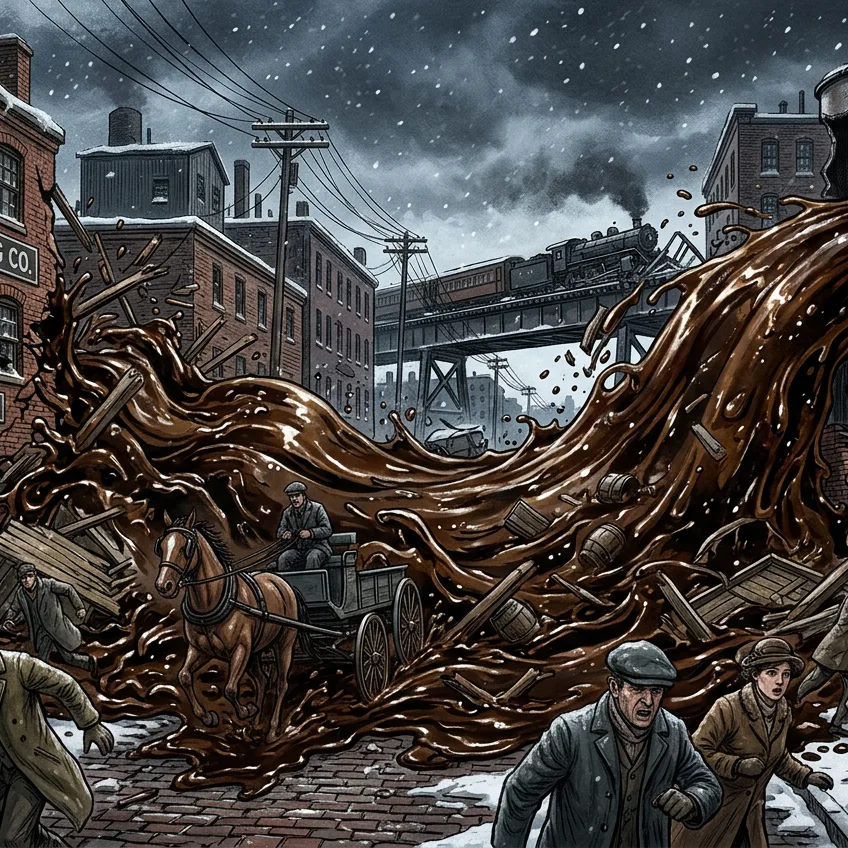
On January 15, 1919, the North End neighborhood of Boston witnessed one of the most unusual and lethal urban disasters in modern history: an unstoppable tide of viscous, scalding syrup. Around noon, a gigantic 15-meter-high storage tank suddenly collapsed, releasing more than 8.7 million liters of fermented molasses.
The rupture of the container produced a roar resembling artillery fire. Within seconds, a liquid wall eight meters high surged through the streets at an estimated speed of 56 kilometers per hour. The colossal mass and density of the fluid multiplied its destructive force: it leveled wooden buildings, bent steel girders, and ripped away the supports of the neighboring elevated railway.
For the victims, escape was nearly impossible. The molasses cooled rapidly in Boston's frigid winter air, turning into a sticky trap comparable to high-density quicksand. The final toll was 21 dead and more than 150 injured.
This event marked critical milestones in contemporary society:
- Pioneering forensic engineering: It was the first major lawsuit in the United States where scientific experts proved that the tank was built with excessively thin steel and without prior structural testing.
- Building regulations: The tragedy forced cities to require signatures from certified engineers and official architectural blueprints before erecting civil works.
Chroniclers of the era claimed for generations that, on the hottest summer days, the air in Boston still carried a subtle, ghostly scent of burnt sugar.
Source: Stephen Puleo, 'Dark Tide: The Great Boston Molasses Flood of 1919' (Beacon Press) / Scientific American