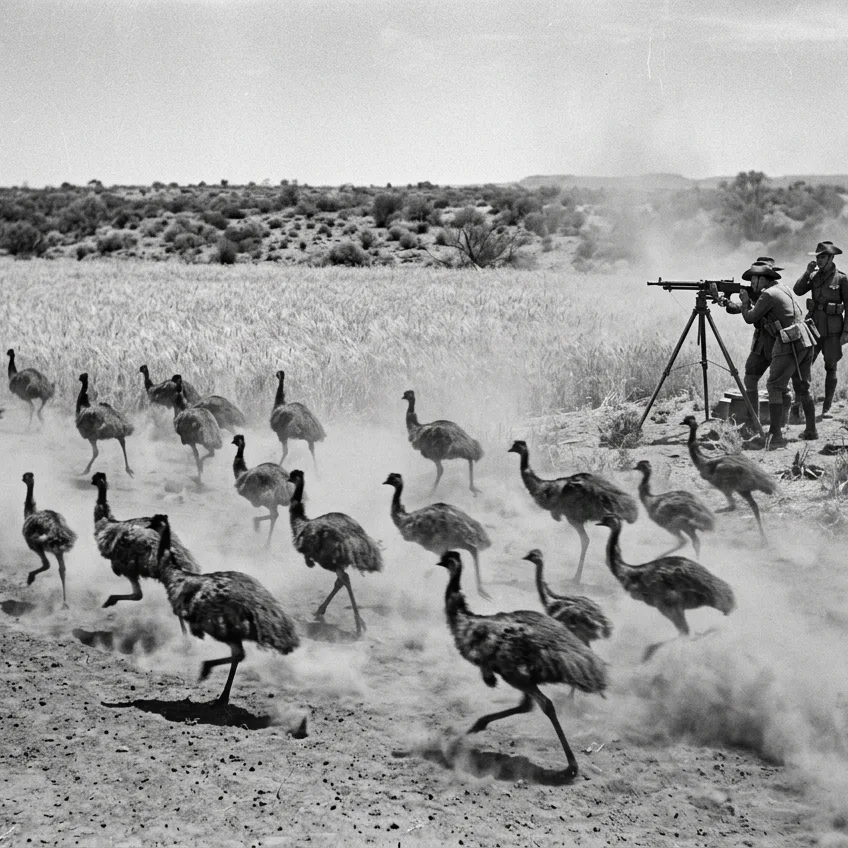
In late 1932, following the Great Depression and a relentless drought in Western Australia, more than 20,000 emus migrating inland invaded the wheat fields of Campion. Settlers, many of them World War I veterans, demanded government assistance over the massive destruction of their crops and fences. Minister of Defence George Pearce authorized the deployment of the Seventh Heavy Battery, equipped with two Lewis machine guns and 10,000 rounds of ammunition.
What the British-Australian military expected to be a simple pest control operation turned into a tactical embarrassment:
- Avian guerrilla tactics: Instead of clumping into dense mobs, the birds scattered at speeds of up to 50 km/h in small disorganized groups as soon as they heard gunshots, leaving the machine guns with no effective target.
- Astonishing resilience: The emus displayed extraordinary physical stamina, running for hundreds of meters even after taking direct hits.
- Logistical failure: The automatic weapons jammed constantly due to dust, and truck-mounted chases proved useless because the rough terrain made accurate aiming impossible.
After exhausting nearly all of their ammunition with only a few hundred birds killed, Parliament ordered a formal troop withdrawal. The commanding officer, Major G.P.W. Meredith, bitterly summarized the defeat: "If we had a military division with the bullet-carrying capacity of these birds it would face any army in the world."
Source: Australian War Memorial / National Archives of Australia