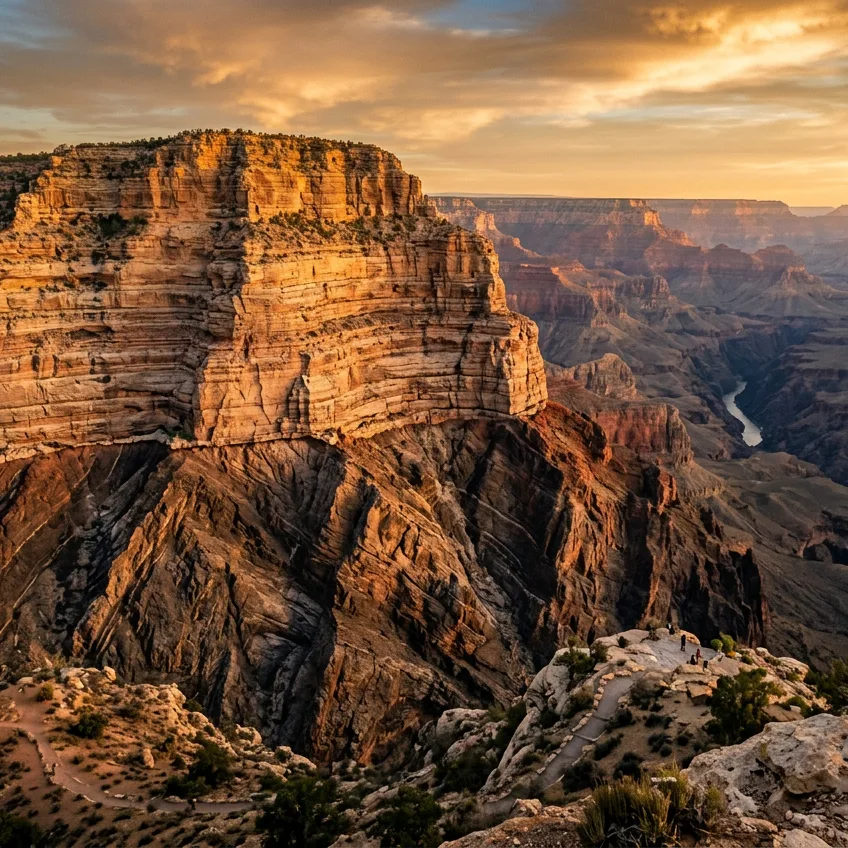
In 1869, during his legendary expedition along the Colorado River, geologist John Wesley Powell discovered a baffling phenomenon etched into the walls of the Grand Canyon: a thin dividing line separated young sedimentary strata from vastly older metamorphic rocks. Between both layers, an enormous volume of geological time was missing. This void, known today as the Great Unconformity, is not unique to North America; it repeats almost identically in Australia, Antarctica, Siberia, and Africa.
In various regions across the globe, up to 1,200 million years of rock history—nearly a quarter of our planet's age—seem to have vanished without a visible trace. For geologists, it is the equivalent of opening a thousand-page history book and finding that four hundred pages were torn out of the most crucial chapter.
Where did such a mountain of terrestrial records go? The most widely supported scientific hypothesis points to the global glaciations of the Cryogenian period, known as Snowball Earth (between 720 and 635 million years ago):
- Massive glacial erosion: Colossal continental ice sheets several kilometers thick advanced like gigantic planers, grinding down and scouring away vertical kilometers of continental crust into the ocean depths.
- The Cambrian trigger: This disproportionate flushing of minerals and sediments poured tons of phosphorus, calcium, and nutrients into the seas, altering water geochemistry and creating the breeding ground that sparked the famous Cambrian Explosion of animal life.
Source: Proceedings of the National Academy of Sciences (PNAS)