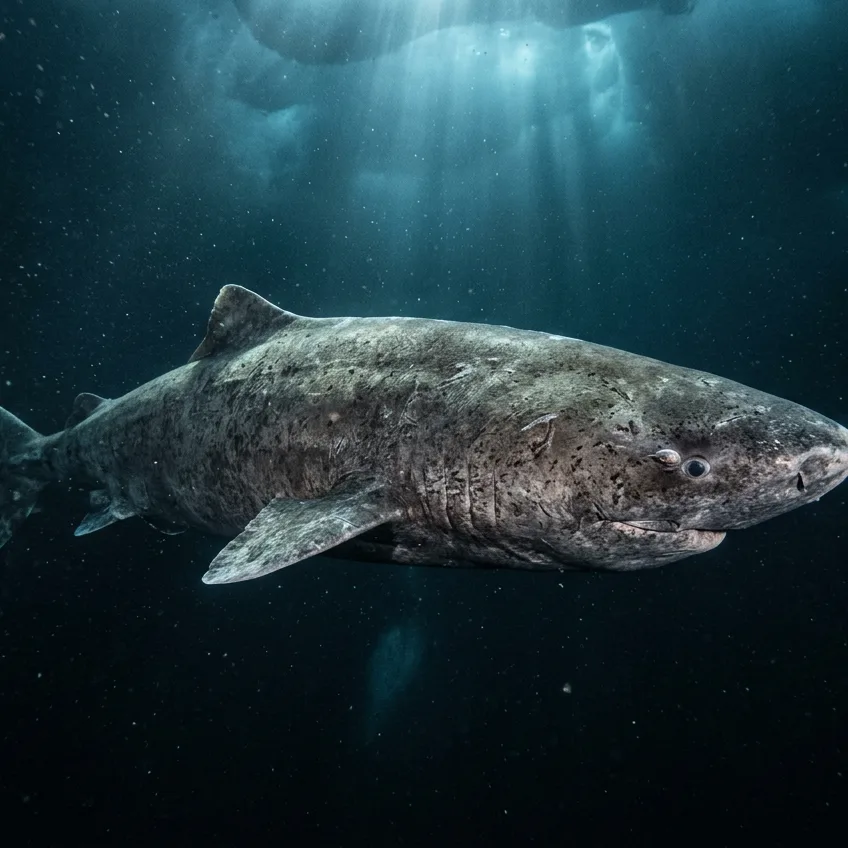
In the frigid, dark depths of the Arctic Ocean lives the Greenland shark (Somniosus microcephalus), a creature up to five meters long that holds the undisputed record as the longest-living vertebrate on Earth. In 2016, a team from the University of Copenhagen analyzed 28 specimens using radiocarbon dating on the proteins of their eye lenses, discovering that the largest female was about 392 years old, placing her birth right in the 17th century.
The secret to this immense longevity lies in its extreme biological lethargy. The animal moves at an average speed of just 1.2 kilometers per hour, and its tissues are packed with trimethylamine oxide, a compound that acts as natural antifreeze and stabilizes its cells against extreme pressure and cold. With a metabolic rate slowed to the bare minimum, its body grows only about one centimeter per year.
Due to this parsimonious development, females do not reach reproductive maturity until they are approximately 150 years old. Furthermore, the vast majority of these sharks live virtually blind due to Ommatokoita elongata, a parasitic copepod crustacean that permanently anchors to their corneas. Despite being blind and moving with ghostly slowness, this silent giant dominates the Arctic food chain by ambushing sleeping prey and scavenging on the abyssal seafloor.
Source: Science (Nielsen et al., 2016: 'Eye lens radiocarbon reveals longevity of the Greenland shark')