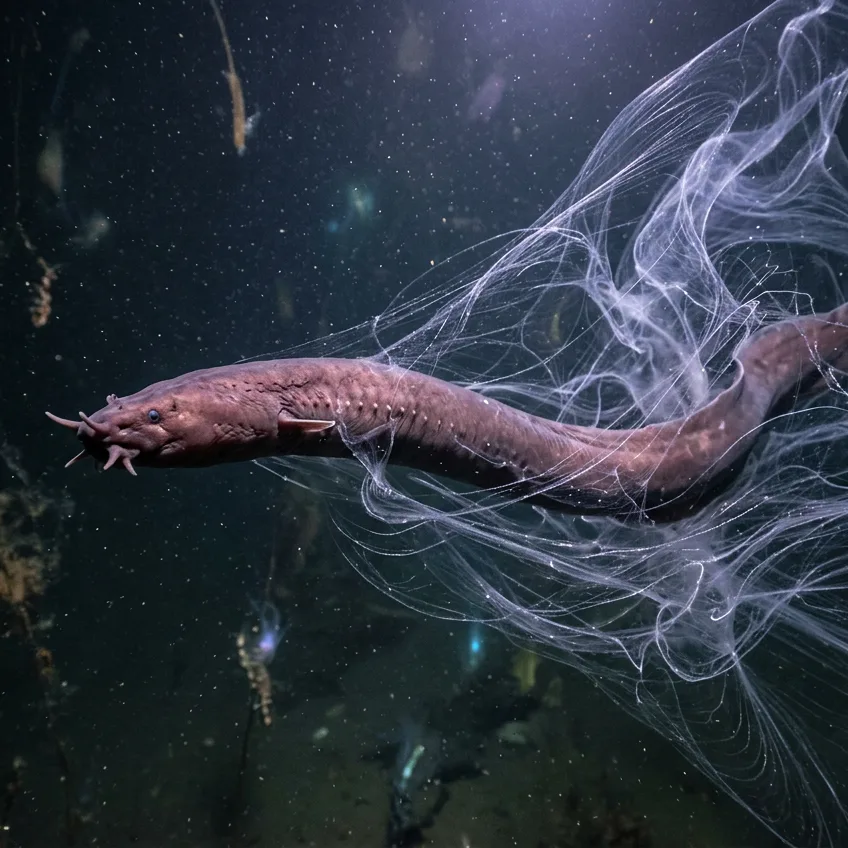
In the gloom of the seabed lives the hagfish, an ancient jawless vertebrate that boasts one of the most spectacular biomechanical self-defense mechanisms on the planet. When a large predator, such as a shark, tries to bite it, the hagfish does not flee: it deploys a chemical countermeasure that deactivates the attack in a fraction of a second.
The secret lies in its lateral dermal glands, loaded with two key components: mucin vesicles and tiny coiled protein skeins wound with microscopic precision. Upon expulsion and contact with saltwater, these skeins unravel at astonishing speed. In less than 400 milliseconds, faster than the blink of an eye, the secretion interacts with the surrounding water and increases its volume up to 10,000 times.
The seawater around the attacker's mouth is transformed almost instantly into a dense web of viscous, extremely elastic gel. This mass seals the hunter's gills, triggering an immediate choking reflex that forces it to release the prey to clear its respiratory passages.
To avoid getting trapped in its own gelatinous snare, the hagfish performs an anatomical feat: it ties itself into an overhand knot and slides it along its flexible body from tail to head, mechanically scraping away the slime before slipping away unharmed. Today, materials engineers are analyzing these protein threads—comparable in strength to spider silk—to design new sustainable biotextiles and hydrophilic medical bandages.
Source: Current Biology / Journal of Experimental Biology



