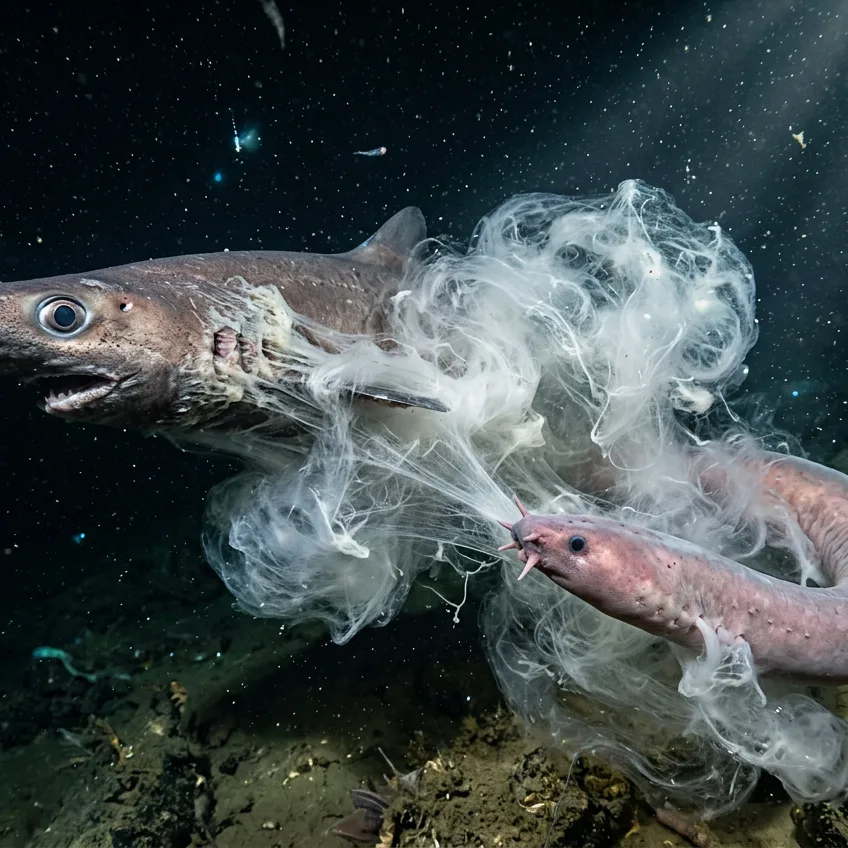
In the ocean depths lives the hagfish, a jawless living fossil creature that possesses one of the most lethal and instantaneous defensive tactics in the animal kingdom: the production of a hyper-reactive slime capable of suffocating any attacker.
When a shark or another large predator attempts to bite a hagfish, the animal expels through tiny pores a millimeter-sized whitish secretion composed of two key elements: microscopic vesicles filled with mucin and cells loaded with skeins of tightly coiled protein threads.
The physical and chemical phenomenon that follows is almost magical:
- Ballistic uncoiling: In less than 100 milliseconds (faster than a blink), contact with seawater breaks the cell membranes and the thread skeins shoot out, expanding up to 10,000 times their volume.
- Extreme-strength fibers: Each thread is barely 1 micrometer thick but reaches several centimeters in length, with a tensile strength comparable to spider silk.
- Mechanical suffocation: The network of fibers traps liquid water, instantly transforming dozens of liters of surrounding water into a dense, elastic gel that clogs the attacker's gills, forcing it to release its prey to avoid suffocating to death.
To avoid choking in its own trap, the hagfish performs a unique maneuver: it ties its own body into a slipknot and slides it along its skin, scraping off the excess slime before swimming away unharmed.
Source: Current Biology / Royal Society Open Science (Biomechanics of Hagfish Slime)