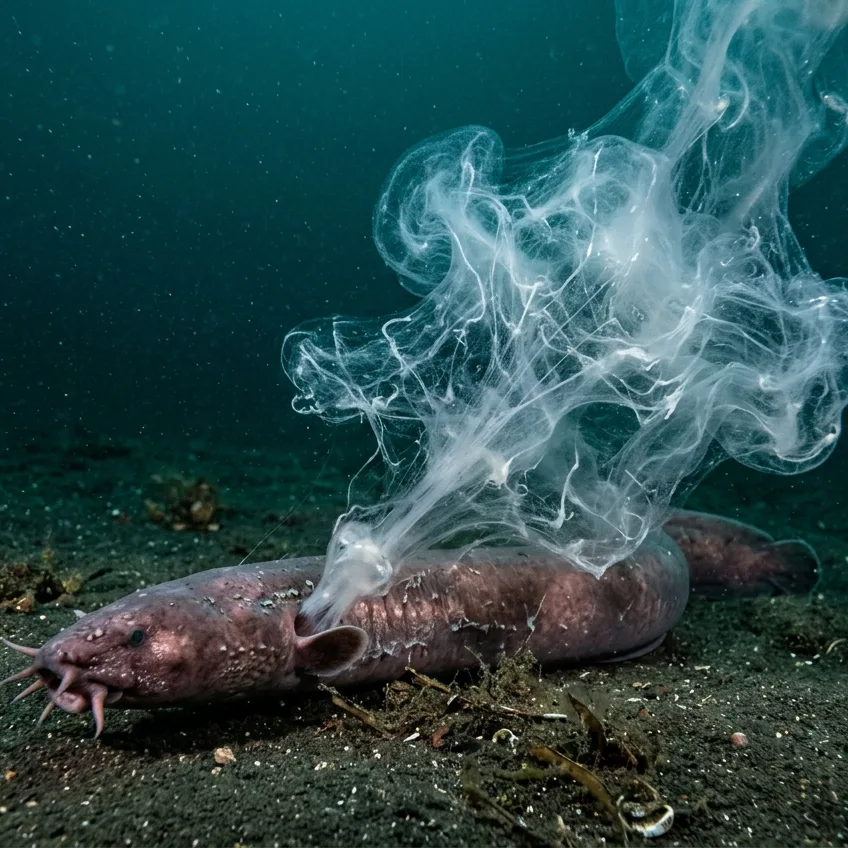
In the depths of the ocean floor lives the hagfish (class Myxini), a primitive jawless vertebrate that possesses one of the most effective defensive strategies in the animal kingdom: a secretion capable of suffocating large marine predators almost immediately.
When a shark or another hunter tries to bite the hagfish, the animal reacts in an imperceptible fraction of time by shooting a milky exudate from nearly a hundred pores located on its flanks. As soon as a fraction of a milliliter of this substance comes into contact with seawater, it expands to more than ten thousand times its volume in less than forty milliseconds, immediately transforming into about twenty liters of thick and ultra-tenacious hydrogel.
The astonishing speed of this reaction is due to an elaborate cellular architecture:
- Skeins of elastic filaments: The glands store cells with keratin-like protein threads, up to fifteen centimeters in length, compacted into micrometric spools that uncoil like released springs.
- Osmotic mucin vesicles: Upon touching saltwater, these vesicles burst and absorb water massively, integrating the liquid mass into the fiber network.
The resulting gel instantly clogs the gills of the attacking fish, inducing mechanical suffocation that forces it to release its prey immediately. To free itself from its own sticky shield, the hagfish employs an ingenious biomechanical trick: it bends its body into a sliding knot and slides it along its skin, scraping off all the viscous mass before slipping away without a single scratch.
Source: Nature Communications / Journal of Experimental Biology