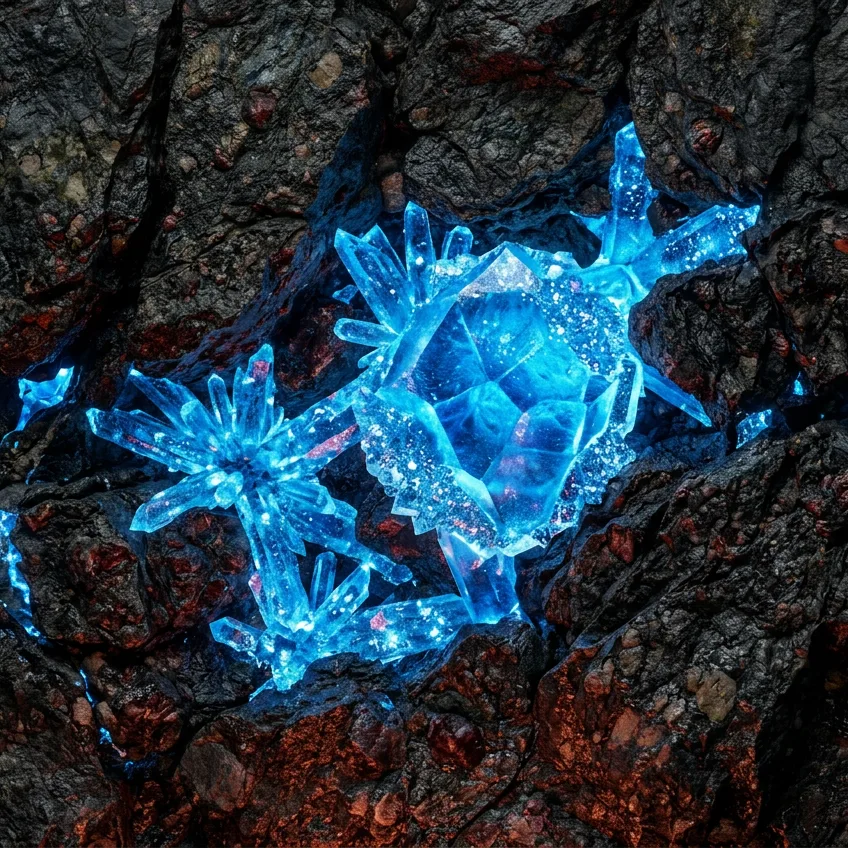
For decades, geologists theorized that the deep interior of our planet hid huge amounts of water, but they lacked direct physical evidence. In 2014, an international team of scientists analyzed a tiny, battered diamond measuring barely three millimeters mined in Juína, Brazil, which had been brought to the surface by a kimberlite volcanic eruption.
At the heart of the gem, they found a microscopic inclusion of ringwoodite, a high-pressure polymorph of olivine that can only form under extreme conditions at depths between 410 and 660 kilometers, in the so-called "transition zone" of Earth's mantle. Until that moment, terrestrial ringwoodite existed only in theoretical models or in meteorites that had survived colossal impacts in space.
The truly revolutionary finding emerged when measuring the crystal's composition: it contained around 1.5% water by weight, stored not as free liquid, but chemically integrated into its molecular structure as hydroxyl ions. Extrapolating this proportion to the total volume of the transition zone:
- It is estimated that this mantle layer stores as much water as all of Earth's surface oceans combined, and could even double that volume.
- It confirms that subducting tectonic plates carry water deep down, driving magma buoyancy and the convection that moves continents.
This discovery showed that Earth is not a dry rocky body on the inside, but a gigantic mineral sponge holding a fossil ocean trapped more than 500 kilometers beneath our feet.
Source: Nature (D. G. Pearson et al., 2014, 'Hydrous mantle transition zone indicated by ringwoodite included within diamond')