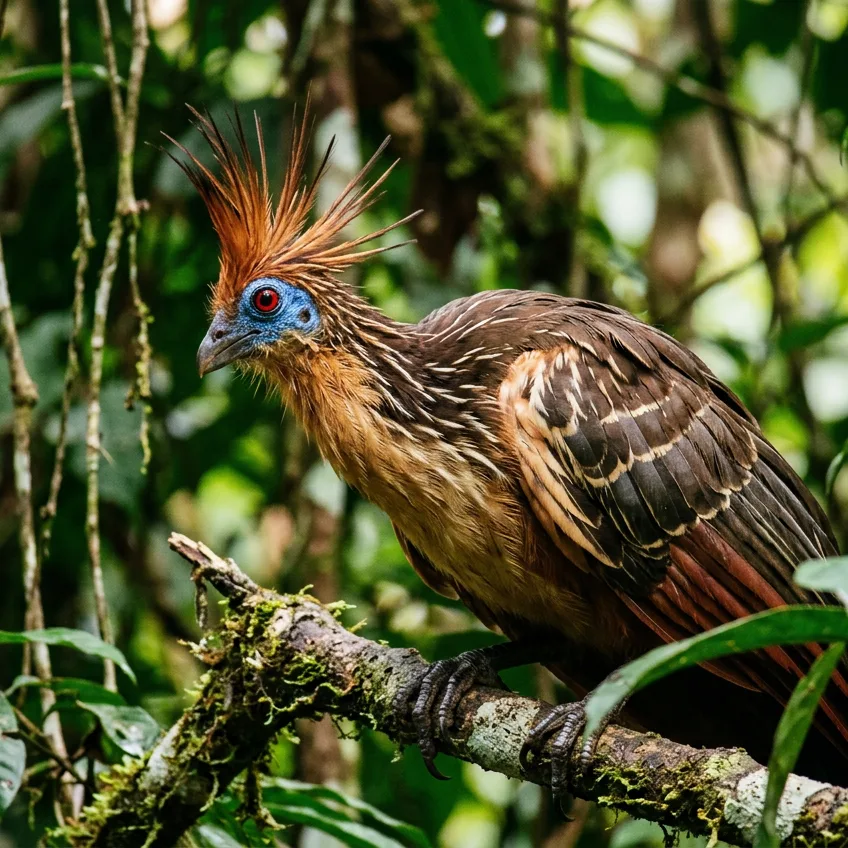
In the swampy depths of the Amazon and Orinoco basins lives one of the most puzzling evolutionary enigmas of the animal kingdom: the hoatzin (Opisthocomus hoazin). This bird, the only surviving member of a lineage isolated more than 60 million years ago, defies almost all anatomical and physiological rules of modern birds.
Its most astonishing feature occurs during the juvenile stage. When a hoatzin chick feels threatened by a predator, it dives without hesitation from the treetops into the water and swims underwater to hide. To return to its nest, it uses two functional claws on the edge of each wing, anatomical vestiges comparable to those of the prehistoric fossil Archaeopteryx, with which it climbs vertical bark before the claws are reabsorbed in adulthood.
As if that were not enough, its digestive system is unique among the planet's birds:
- Foregut fermentation: It has an enlarged crop divided into chambers where millions of symbiotic bacteria break down the cellulose in leaves, a process identical to that of ruminants such as cows.
- Muscle-less breast: Its massive crop takes up so much space in the chest that it has atrophied its pectoral muscles, making it a clumsy and heavy flier.
- Characteristic odor: Due to the continuous plant fermentation, it exhales a pungent scent similar to fresh cow manure, which is why it is popularly nicknamed the "stinkbird."
The hoatzin represents a fascinating living bridge between the evolution of theropod dinosaurs and nature's most extreme metabolic solutions.
Source: Science (Journal) / Proceedings of the National Academy of Sciences (PNAS)