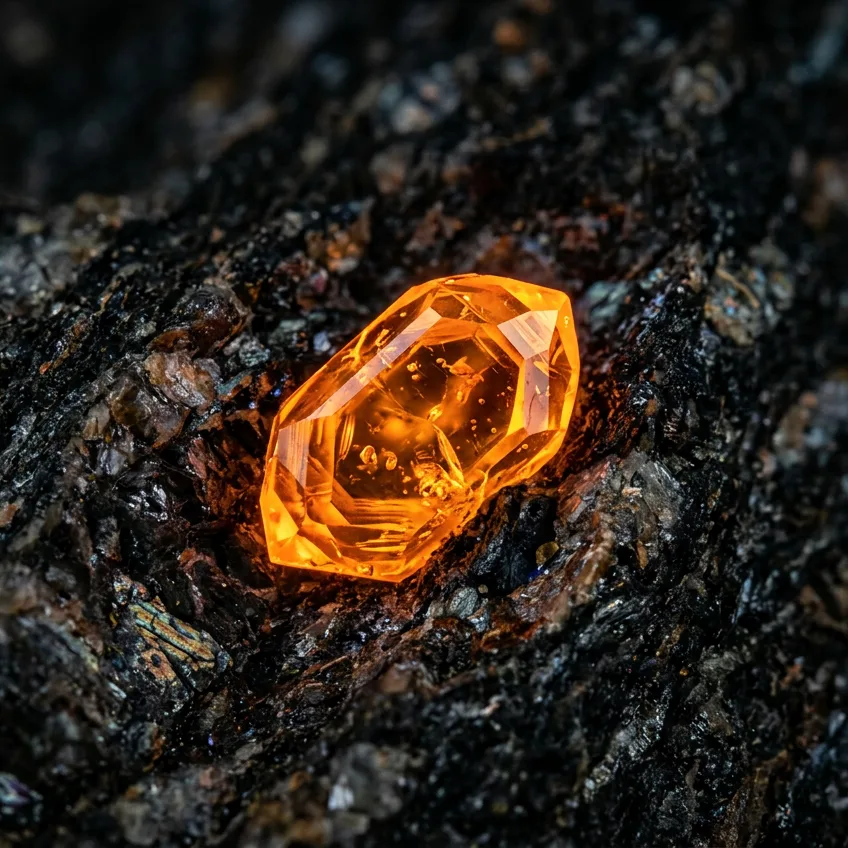
For decades, geology textbooks maintained that the Hadean eon—the planet's first five hundred million years—was a purely hellish wasteland, ravaged by relentless cosmic impacts and covered exclusively by oceans of incandescent magma. However, in a remote rock formation in Jack Hills, Western Australia, a group of microscopic crystals changed that canonical view forever.
These are detrital zircons, zirconium silicate minerals extraordinarily resistant to pressure, chemical weathering, and extreme temperatures. Because they incorporate uranium atoms into their crystal lattice but reject lead upon formation, they function as near-perfect geological clocks. By dating the isotopes of these zircons, scientists identified specimens 4,404 million years old: the oldest fragments of terrestrial rock ever found, originating just one hundred fifty million years after the consolidation of the planet.
The most startling discovery came from their internal geochemistry. Using ion microprobes, researchers analyzed the concentrations of oxygen-18 in the crystal structure. This heavy isotopic signature occurs only when molten magma interacts with liquid water at moderate surface temperatures. The zircons proved that, instead of a global ocean of lava, early Earth already had a solid crust, an active hydrological cycle, and stable oceans, shifting back by hundreds of millions of years the chronological window in which life could have originated.
Source: Nature (Wilde et al., 2001: 'Evidence from detrital zircons for the existence of continental crust and oceans on the Earth 4.4 Gyr ago')