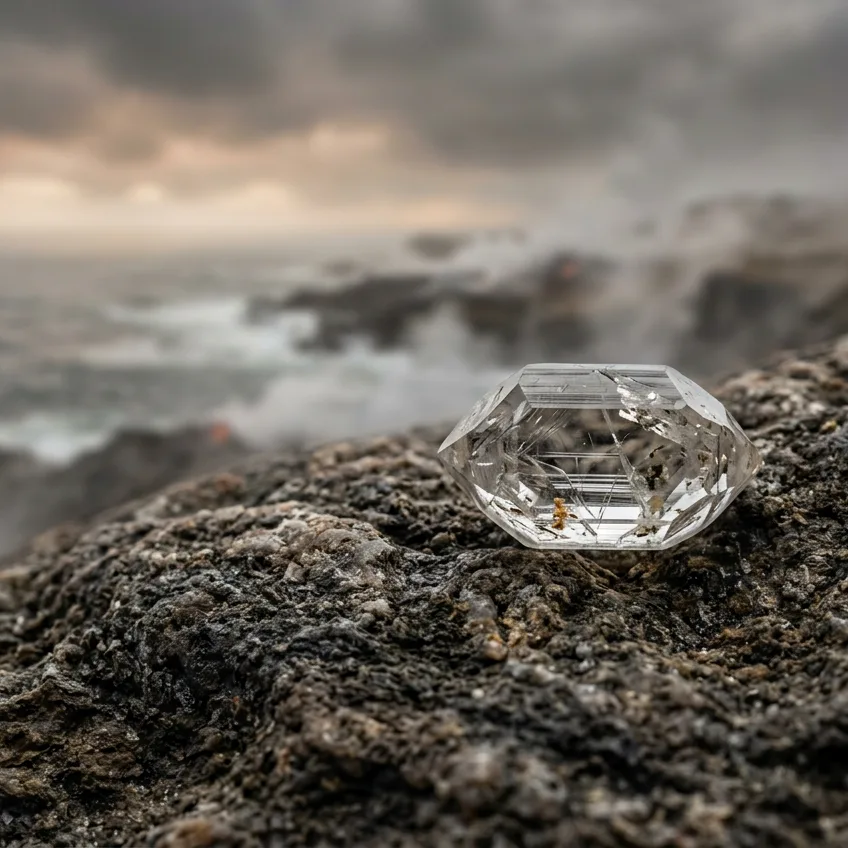
For decades, geology textbooks described the Hadean eon—the first 500 million years of our planet—as a truly Dantean inferno: a global ocean of boiling magma relentlessly bombarded by asteroids, incapable of sustaining solid crust or liquid water. However, a handful of microscopic crystals found in the Jack Hills, in Western Australia, shattered this paradigm.
These are zircons (zirconium silicate), chemically nearly indestructible minerals that act as true geological black boxes. As they form, they trap traces of uranium that slowly decay into lead, making it possible to date their birth with astonishing precision. In 2014, the analysis of one of these fragments, barely thicker than two human hairs, set its age at 4,375 million years: the oldest piece of Earth's crust ever discovered, forged just 160 million years after Earth's formation.
The most revolutionary finding was not just its antiquity, but its isotopic composition:
- Oxygen-18 ratio: Geochemical analysis revealed a heavy isotopic signature that only forms when magma interacts with rocks previously altered by cold liquid water.
- The cool early Earth hypothesis: The presence of these zircons proved that Earth cooled much faster than estimated, forming solid continental crust and likely the first oceans shortly after the planet was born.
Thanks to these tiny quartz and zirconium survivors, we know that the chemical conditions to support life could have emerged hundreds of millions of years earlier than science suspected.
Source: Nature Geoscience (Valley et al., 2014 - 'Hadean age for a post-magma-ocean zircon confirmed by atom-probe tomography')