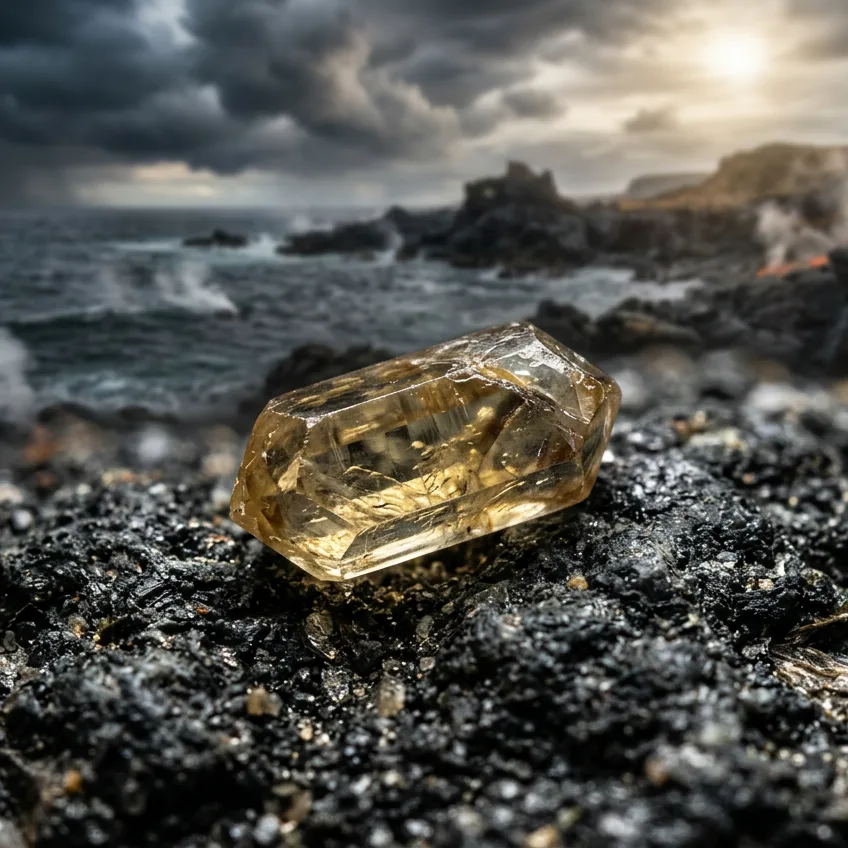
For decades, geologists assumed that the Hadean eon—the first 500 million years following the birth of Earth—was an unforgiving hell: a global sea of boiling magma, battered by asteroids, and completely incapable of harboring liquid water. However, in a remote range of eroded hills in Western Australia called Jack Hills, tiny mineral grains measuring just a fraction of a millimeter changed the history books forever.
These are zircon crystals (zirconium silicate), virtually indestructible mineral structures that survive titanic pressures, partial melting, and repeated cycles of erosion. By radiometrically dating the decay of uranium into lead trapped within their crystal lattice, geochemists discovered specimens up to 4,404 million years old, making them the oldest fragments of Earth's crust ever identified.
The most momentous finding emerged from analyzing their oxygen isotope ratios. The zircons displayed a clear chemical signature of enriched oxygen-18, a footprint generated only when magmatic rocks interact directly with surface liquid water at moderate temperatures.
This small mineralogical detail proved that, just 150 million years after its violent formation, Earth was no longer an incandescent ball; it had cooled enough to form a stable solid crust and host the first oceans, pushing forward the hospitable window for life by hundreds of millions of years.
Source: Nature (Valley et al., 2014 - 'Hadean age for a post-magma-ocean zircon confirmed by atom-probe tomography')