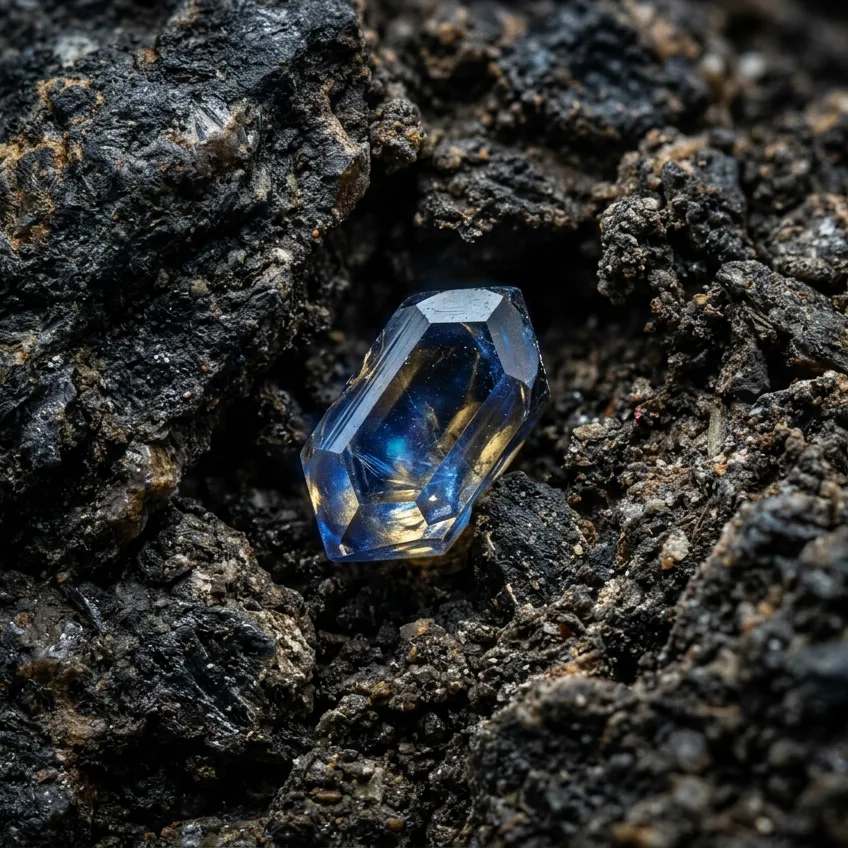
For more than a century, geologists assumed that Earth during its Hadean eon (between 4,600 and 4,000 million years ago) was a barren hell devoid of solid crust, dominated by oceans of boiling magma and constant meteorite bombardments. However, in 2001, a team of scientists found in the Jack Hills of Western Australia irrefutable proof that early geological history was completely different: microscopic zircon crystals dating back 4,404 million years.
Zircon (zirconium silicate) is practically indestructible. It can withstand erosion, colossal pressures, and extreme temperatures without altering its crystal lattice. By analyzing uranium and lead impurities inside them, researchers managed to date with nanometric precision the oldest terrestrial object ever discovered.
What was truly revolutionary emerged from measuring the ratio of oxygen isotopes (oxygen-18 versus oxygen-16) trapped in these millimeter-sized crystals:
- Traces of liquid water: The isotopic signature could only have formed if the original parent rock had reacted with surface liquid water at moderate temperatures.
- Early continental crust: It proved that barely 150 million years after the planet formed, solid continental masses already existed.
- Conditions for life: Instead of a global sea of lava, the early Earth harbored cool oceans capable of supporting prebiotic chemistry.
Thanks to these tiny time capsules the size of a pinhead, geology discarded the myth of a perpetual hell and discovered that our planet cooled at a dizzying pace.
Source: Nature (Wilde et al., 2001) / Earth and Planetary Science Letters