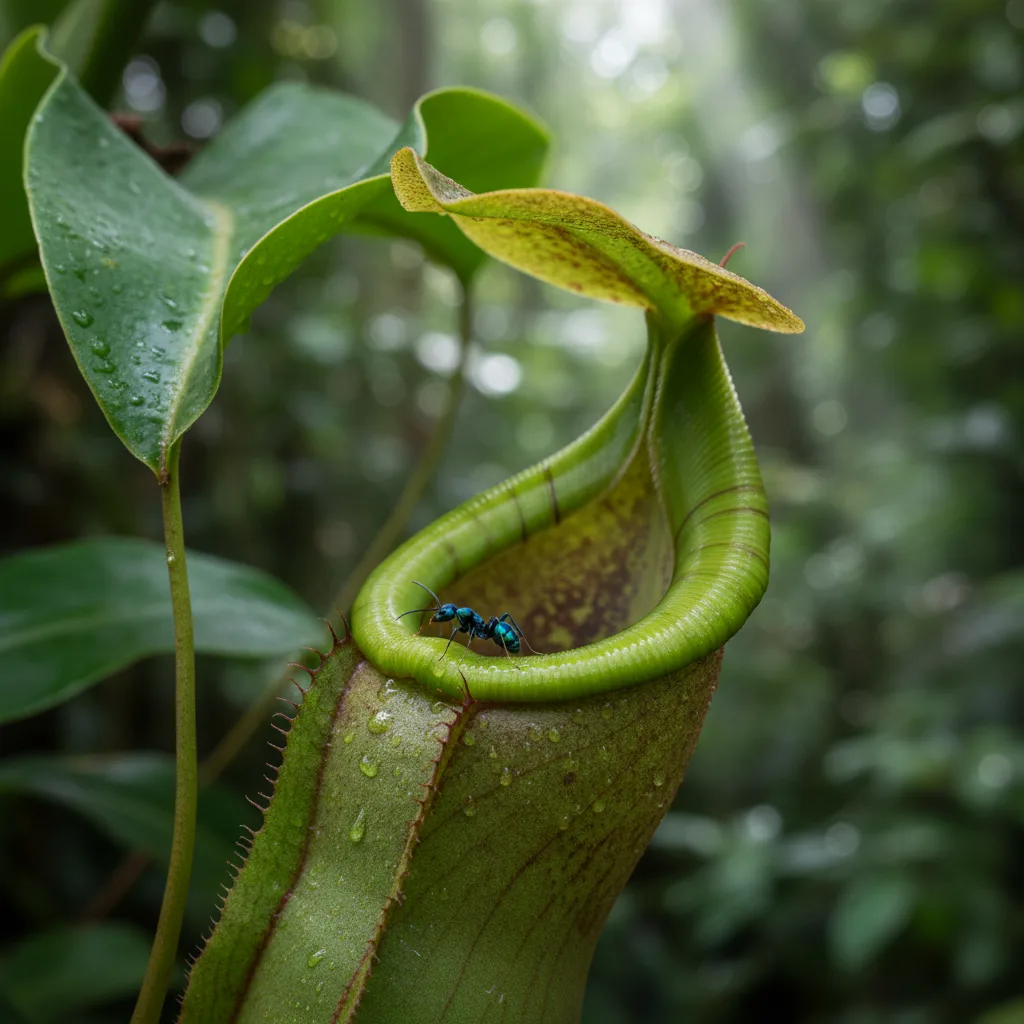
In the humid rainforests of Southeast Asia, where soils are poor in nutrients, a group of carnivorous plants thrives with a truly astonishing hunting technique: pitcher plants of the genus Nepenthes. These botanical wonders have evolved to supplement their diet by capturing and digesting animals, mainly insects.
Their trap is a modified leaf shaped like a pitcher or cup, often vibrantly colored and featuring a rim (peristome) that secretes nectar to attract victims. The secret to its lethality lies precisely in this peristome: when wet from rain or condensation, its microscopically textured surface becomes incredibly slippery. A study published in PNAS in 2016 revealed that this surface can make an insect fall 100 times more likely than on normal wet surfaces.
Once the insect, attracted by the sweet nectar, steps onto the rim, it loses its footing and slides into the pitcher. There, a digestive fluid—a mixture of water and proteolytic enzymes similar to those in our own stomach—waits to dissolve the prey. Some Nepenthes species are so large that they can trap and digest small vertebrates like frogs, lizards, or even rodents. This strategy allows them to obtain essential nitrogen and phosphorus, vital for their survival in hostile environments.
Source: PNAS (Proceedings of the National Academy of Sciences), Royal Botanic Gardens, Kew, National Geographic.



