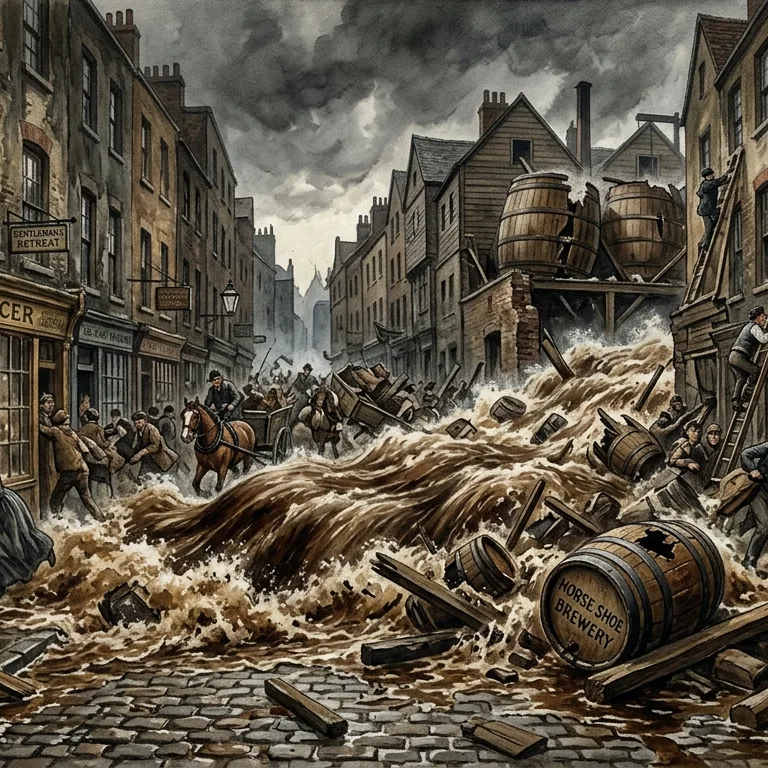
On the afternoon of October 17, 1814, the St Giles neighborhood in London witnessed one of the most bizarre and tragic urban disasters of the industrial era. At the Horse Shoe Brewery, owned by Meux & Co., colossal wooden vats over six meters high were used to store fermenting beer. One of the twenty-two-ton iron hoops securing the main vat snapped under the strain.
The sudden depressurization triggered an immediate chain reaction: the unleashed force burst other adjacent vats, releasing a destructive wave of approximately 1.4 million liters of porter beer. An exterior brick wall collapsed under the hydraulic pressure, and a viscous wave over four meters high rushed into the impoverished New Street alley.
- Instant destruction: The torrent demolished two precarious homes and filled the basements inhabited by impoverished families within seconds.
- Fatalities: 8 people lost their lives, mostly women and children, drowned or crushed by the debris of collapsed buildings.
- Judicial ruling: Despite the evident structural negligence, the coroner's jury determined that the catastrophe was an "Act of God," absolving the brewers of criminal liability.
The disaster nearly bankrupted the company, but the British Parliament decided to refund the excise duties paid in advance on the lost drink, saving the business. In the wake of this tragedy, the brewing industry permanently phased out gigantic wooden vats in favor of concrete-lined tanks.
Source: The London Beer Flood of 1814 (Historic UK / The History Press)