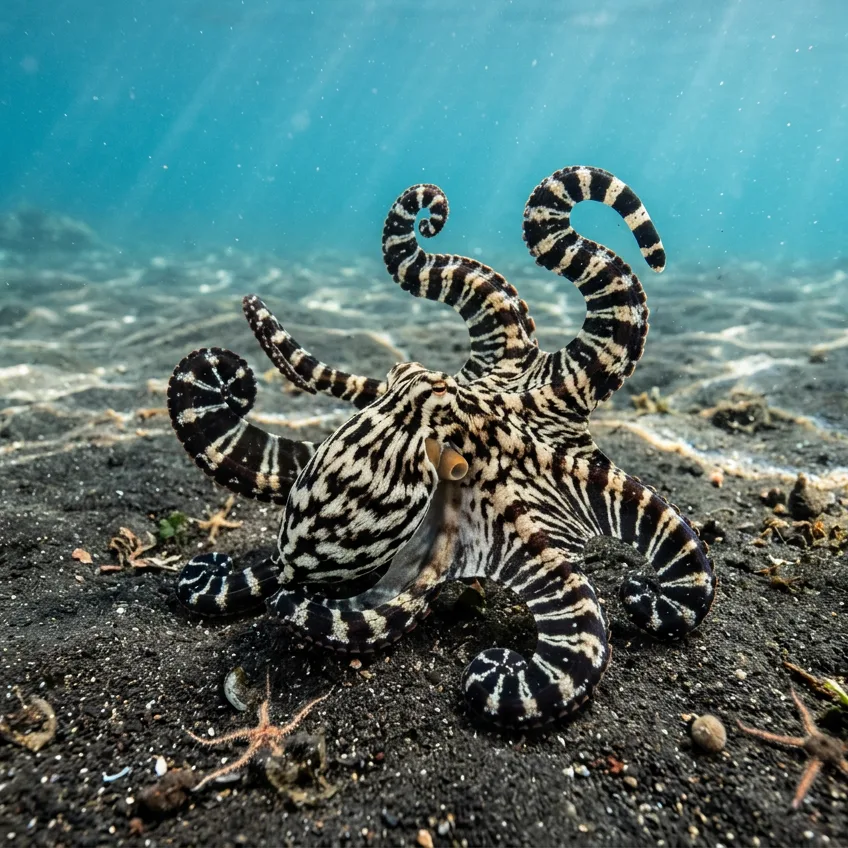
On the sandy and muddy bottoms of Indonesia, in the late 1990s, marine biologists stumbled upon an evolutionary marvel: the mimic octopus (Thaumoctopus mimicus). While most cephalopods use passive camouflage to blend in with rocks or corals, this species takes deception to an unmatched theatrical level, deliberately adopting the appearance, texture, and movements of at least 15 different marine animals.
What is most extraordinary lies not only in its boneless physical malleability, but in its situational tactical intelligence. Scientists discovered that the mimic octopus does not improvise at random, but chooses which creature to imitate based on the specific threat. For example, when harassed by territorial damselfish, the octopus buries six of its tentacles in the sand and extends the remaining two, banded in black and yellow, in opposite directions, undulating them rhythmically to pass as a banded sea snake, a lethal predator of those fish.
When it needs to travel quickly across exposed open areas, it gathers all its arms together and adopts a flattened wedge shape, swimming undulatingly like a venomous sole fish. In other circumstances, it splays its limbs with apparent spines to simulate an intimidating lionfish, or floats contracting like a stinging jellyfish.
Formally described in 2005 by Australian biologist Mark Norman, this animal proved that dynamic mimicry can involve real-time decision-making processes, cementing the mimic octopus as one of the ocean's most astounding strategists.
Source: Norman, M. D., Finn, J., & Tregenza, T. (2001). Dynamic mimicry in an Indo-Malayan octopus. Proceedings of the Royal Society of London. Series B: Biological Sciences, 268(1478), 1755-1758.



