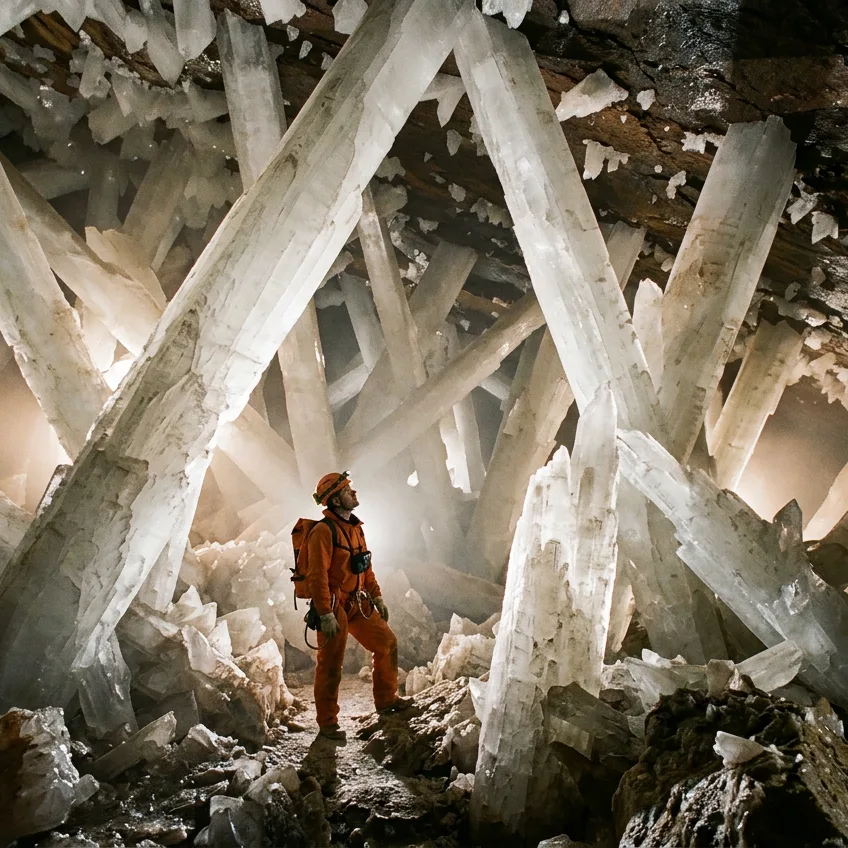
At a depth of 300 meters, inside a lead and silver mine in Chihuahua (Mexico), lies one of the planet's most extraordinary mineral wonders: the Cave of the Crystals of Naica. Discovered accidentally in the year 2000, this chamber houses colossal translucent selenite beams (a variety of gypsum) measuring up to 11.4 meters in length and weighing more than 50 tons.
The origin of these geological giants is a masterclass in physical and chemical balance:
- The natural thermostat: The cave remained completely flooded for at least 500,000 years with waters rich in calcium sulfate, heated by a magma chamber located several kilometers beneath the ground.
- The critical 58 °C window: The water temperature stayed nearly invariant between 54 °C and 58 °C. Above this threshold, the mineral remains as anhydrite; below it, it crystallizes too quickly into millions of tiny grains. By staying within that extremely narrow thermal margin, the crystals grew at an infinitesimal pace, atom by atom.
For the scientists who managed to explore it, the environment posed an authentic biological hell. With an ambient temperature of 58 °C and relative humidity of up to 99%, the human body cannot sweat to cool down; the hot air condenses water inside the lungs, so visits required ice-refrigerated suits and were limited to barely fifteen minutes. In 2015, artificial water pumping from the mine stopped and the cave flooded once again, sealing its lethal atmosphere and preserving its growth for the geological future.
Source: García-Ruiz, J. M. et al. (2007). 'Formation of natural gypsum megacrystals in Naica, Mexico'. Geology.