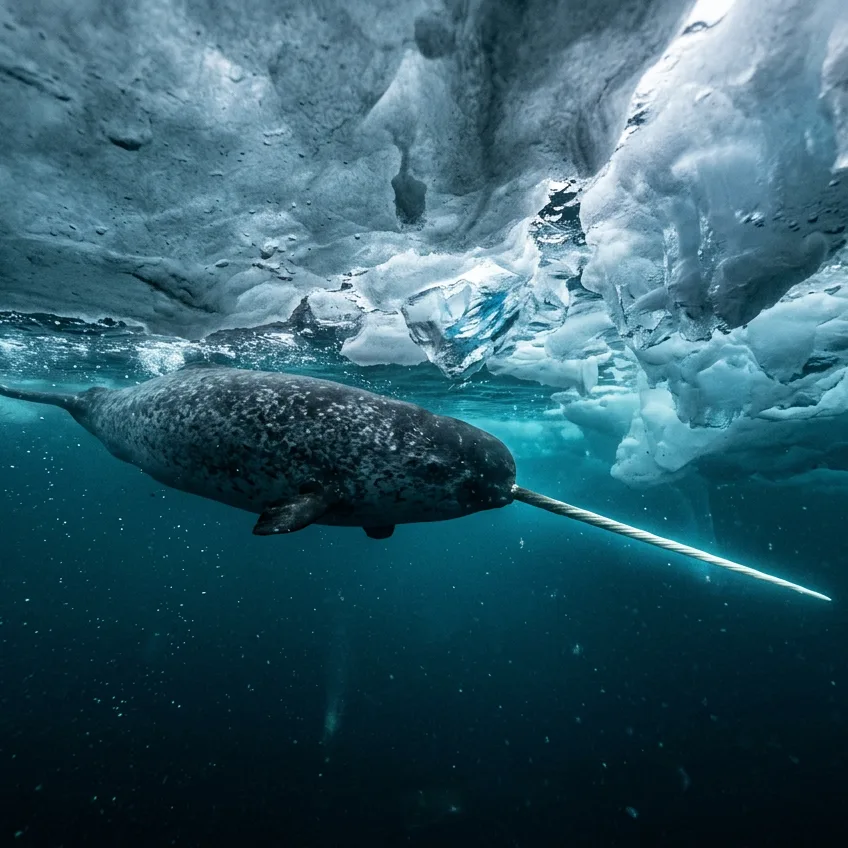
For centuries, the enigmatic spiral appendage of the narwhal (Monodon monoceros) fueled the European legend of unicorns. However, the biological reality of this structure is even more astonishing: it is neither a bony horn nor an offensive weapon to pierce prey, but an overgrown left canine that pierces the upper lip and can reach up to three meters in length.
Unlike almost all mammalian teeth, whose dentin and pulp are sealed beneath hard protective enamel, the narwhal tusk is structured "inside out." Its outer surface lacks enamel and is lined with a dense network of microscopic tubules open directly to the icy Arctic water. Research led by evolutionary dental researcher Martin Nweeia revealed that this tooth houses nearly ten million nerve endings connected directly to the cetacean's brain.
This extraordinary architecture transforms the tusk into a hydrodynamic sensory organ capable of detecting:
- Salinity gradients: vital for anticipating water freezing and locating escape routes beneath ice floes.
- Fluctuations in temperature and pressure: which guide their dives to depths greater than 1,500 meters.
- Chemical particles: associated with schools of cod or receptive females across the vastness of the ocean.
When males rub their tusks at the surface—a behavior known as tusking—they not only resolve dominance hierarchies nonviolently, but also exchange direct sensory information about the water masses they have just crossed.
Source: Harvard School of Dental Medicine / National Geographic Society (Dr. Martin Nweeia et al., The Anatomical Record)