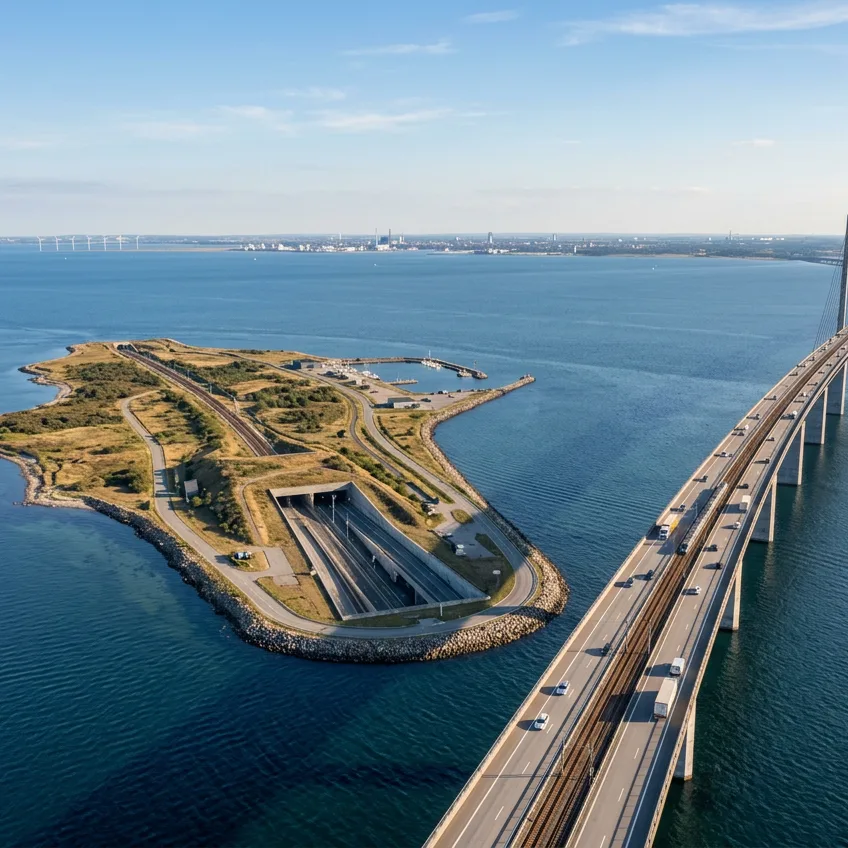
Connecting Copenhagen (Denmark) and Malmö (Sweden) across the Øresund strait posed a seemingly insurmountable challenge for civil engineering. Building a conventional high-level bridge interfered with landing maneuvers at nearby Copenhagen Airport, Kastrup, while erecting a low suspension bridge blocked crucial Baltic maritime traffic routes. Finally, excavating a sixteen-kilometer tunnel proved astronomically expensive and unfeasible.
The engineers' answer was an unprecedented hybrid solution inaugurated in the year 2000:
- The cable-stayed colossus: a nearly eight-kilometer-long, double-deck viaduct (lower railway and upper highway) that starts on Swedish soil with 204-meter-high pylons.
- The artificial island of Peberholm: a four-kilometer strip of land raised from scratch in the middle of the strait using 1.6 million cubic meters of rock and 7.5 million of sand dredged from the seabed.
- The Drogden submerged tunnel: twenty precast concrete blocks weighing 55,000 tons each, towed and sunk into a marine trench to dive traffic beneath the waves to the Danish shore.
Thanks to this transition on the island of Peberholm, ships navigate over the tunnel and planes fly over the area without vertical obstacles. In addition, Peberholm became an unintended ecological laboratory: closed to all human access except for scientists, nature has spontaneously colonized the land, today hosting botanical and bird species once thought extinct in the region.
Source: Øresundsbron Official Technical Archive / Danish Road Directorate