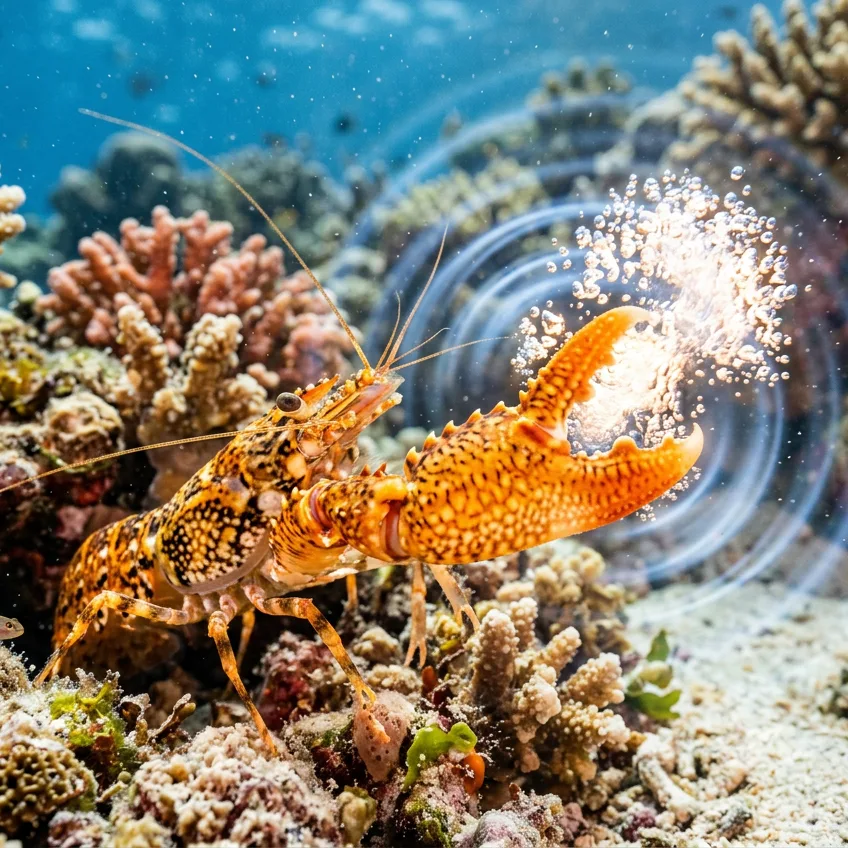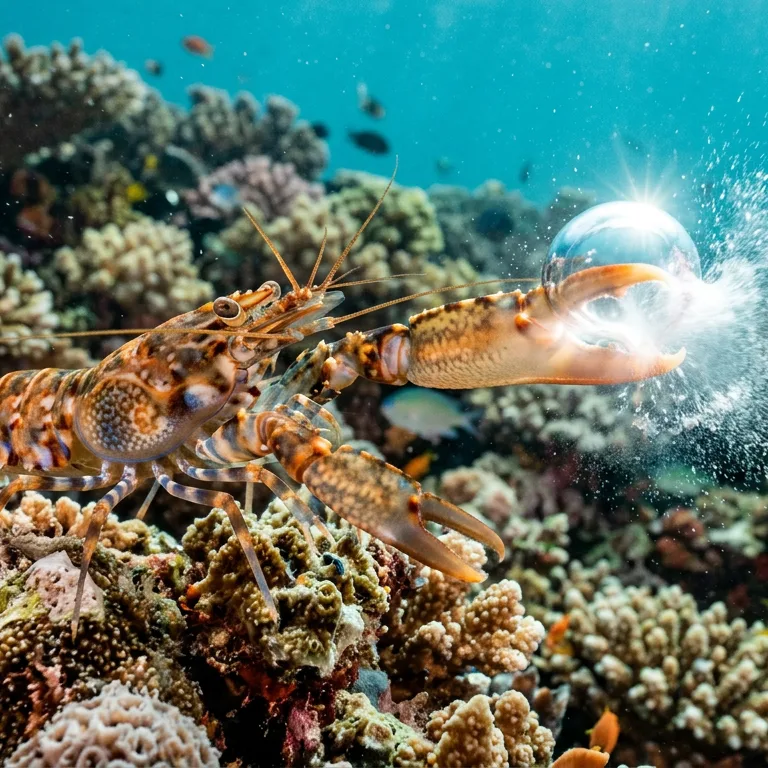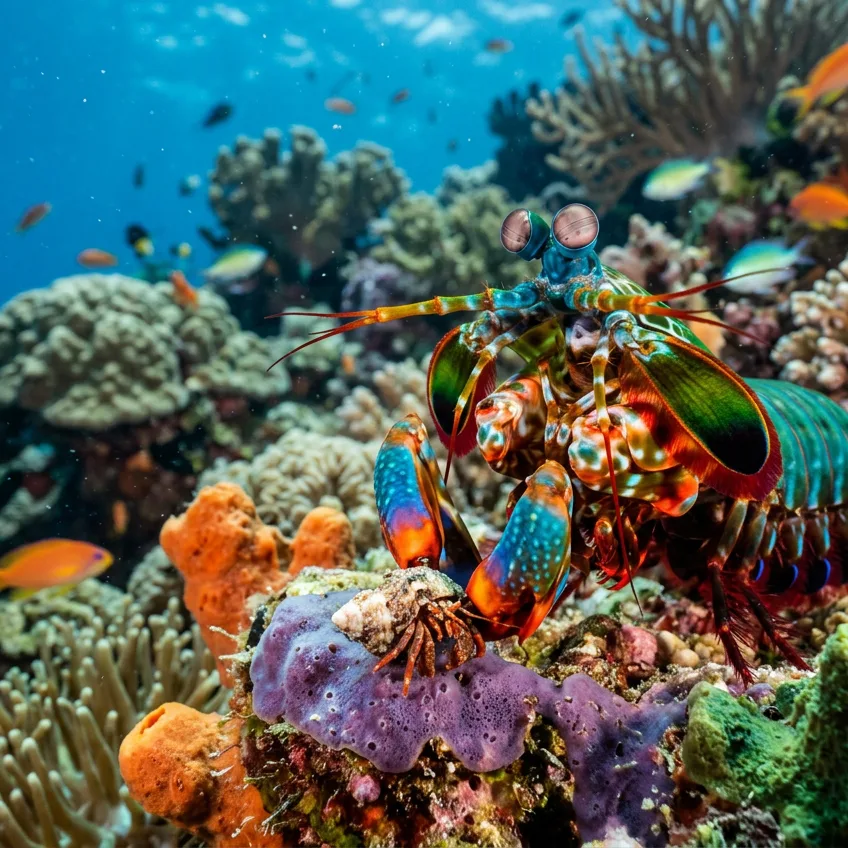
In the coral reefs of the Indo-Pacific region lives one of the most formidable predators in the animal kingdom: the peacock mantis shrimp (Odontodactylus scyllarus). Despite measuring only between 10 and 18 centimeters, this crustacean possesses nature's most lethal raptorial appendages, designed to strike hard-shelled prey like crabs and snails with unusual biomechanical violence.
Its attack mechanism functions like a microscopic crossbow: it stores elastic energy by tensing a saddle-shaped sclerite until abruptly releasing it. The appendage reaches a speed of 80 km/h with an acceleration exceeding 10,400 g, similar to that of a bullet fired from a firearm.
This movement is so brutal that it triggers two amazing phenomena:
- Lethal supercavitation: The extreme speed instantly displaces surrounding water, creating a vacuum bubble whose implosion generates a destructive secondary shock wave, temporary heat of nearly 4,500 °C, and a flash of light.
- Bulletproof structure: Its clubs are made of helicoidal layers of hydroxyapatite and chitin capable of dissipating microcracks, a design that does not fracture and currently inspires military armor.
As if that were not enough, its eyes have twelve independent color photoreceptors—compared to three in humans—and it is the only known animal capable of perceiving circularly polarized light.
Source: Science (American Association for the Advancement of Science) / Journal of Experimental Biology