For over a century, biology maintained as an unbreakable dogma that photosynthesis was an exclusive privilege of plants, algae, and certain bacteria, while the complex immune system of vertebrates would immediately annihilate any plant cellular intruder. However, in 2011, a team of scientists led by biologist Ryan Kerney discovered an unprecedented exception in nature: the spotted salamander (Ambystoma maculatum).
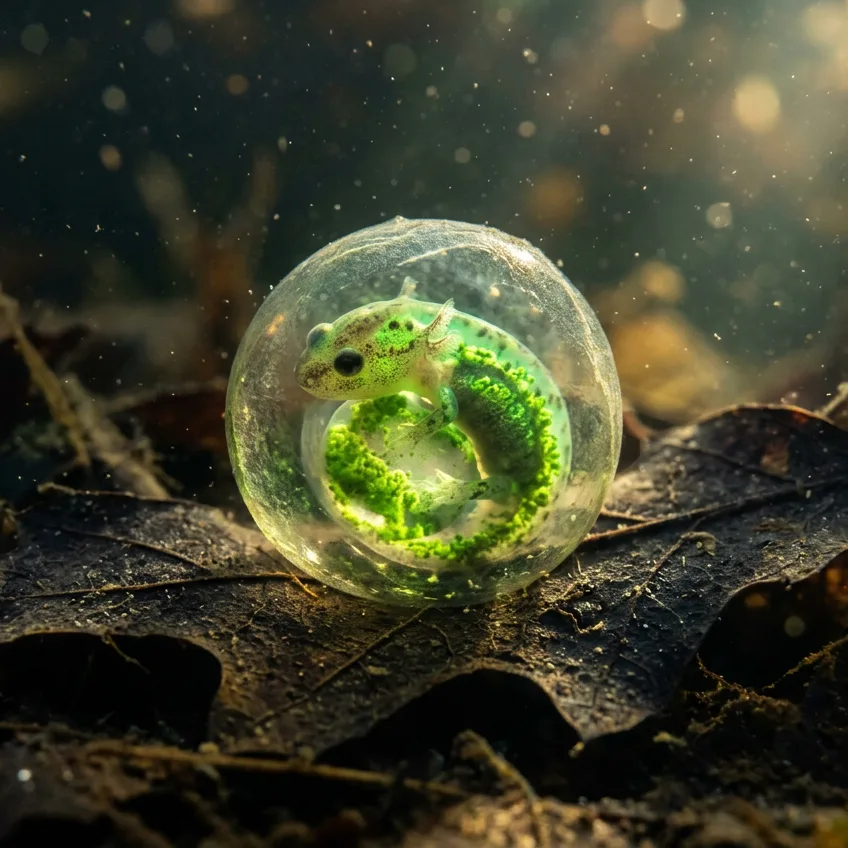
Scientists had known for decades that the egg clutches of this North American amphibian displayed a bright green hue due to a symbiotic relationship with the single-celled alga Oophila amblystomatis (whose name literally means 'salamander egg lover'). What was truly revolutionary occurred when analyzing the embryos with advanced fluorescence microscopy: the algae not only surrounded the jelly capsule, but also penetrated the interior of the amphibian's embryonic cells themselves.
Inside the cellular tissue of the salamander, the algae continue to perform active photosynthesis, providing crucial metabolic advantages:
- Direct oxygen injection: The alga generates molecular oxygen inside the embryo's cells, drastically accelerating its growth and survival rate.
- Glucose on demand: It provides energetic byproducts derived from sunlight in exchange for the amphibian's nitrogenous waste.
- Immunological truce: The salamander's cells deliberately deactivate rejection signals to allow the alga to coexist within their cytoplasm.
This finding demonstrated for the first time that a vertebrate can coexist at an intracellular level with a photosynthetic organism, blurring the evolutionary boundary between the plant and animal kingdoms.
Source: Proceedings of the National Academy of Sciences (PNAS) / Dalhousie University