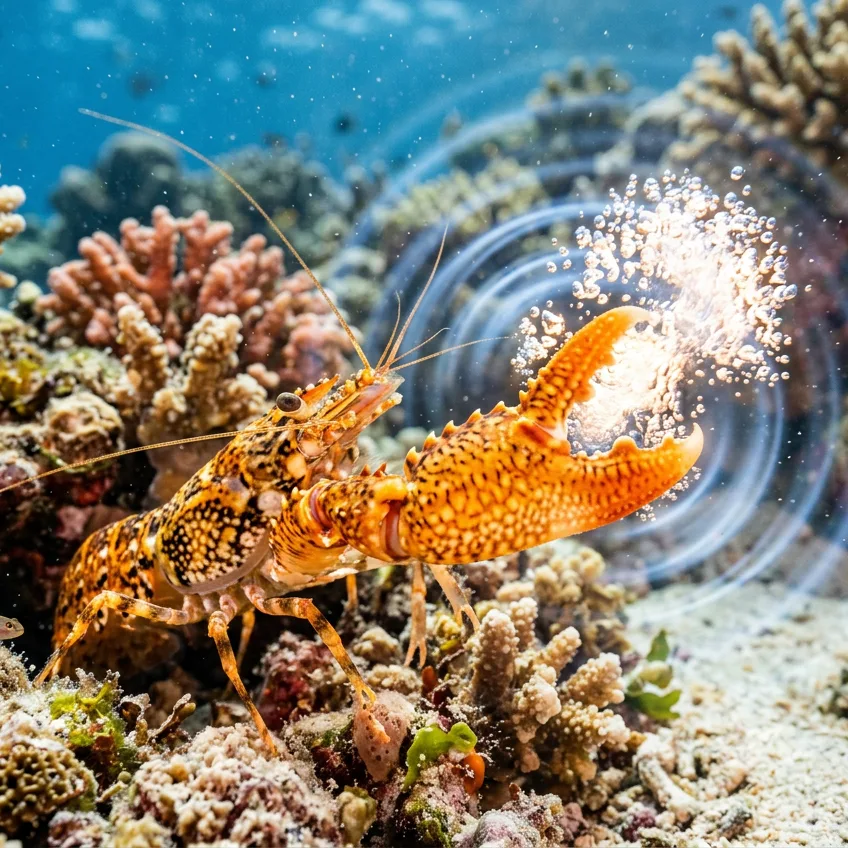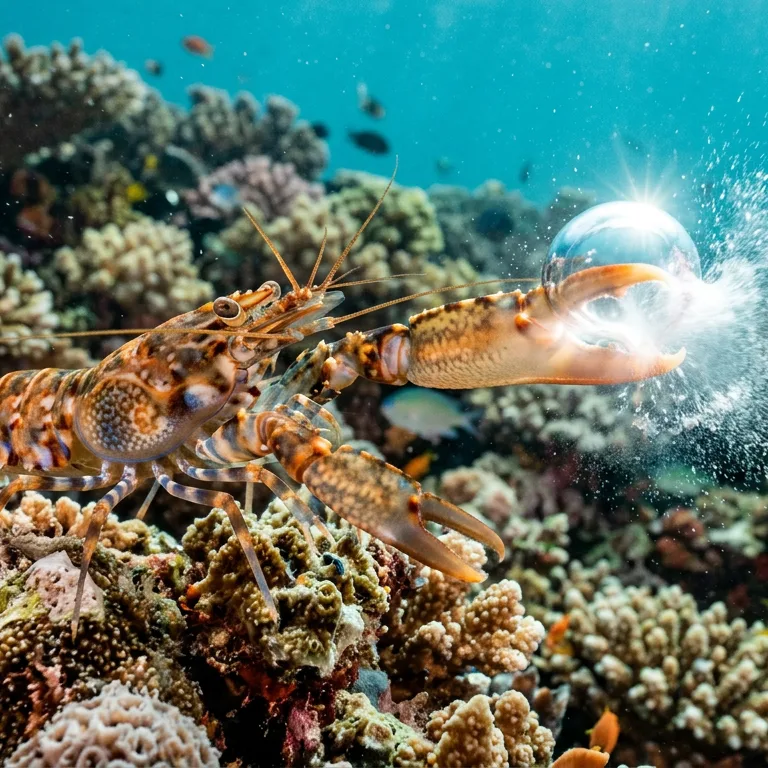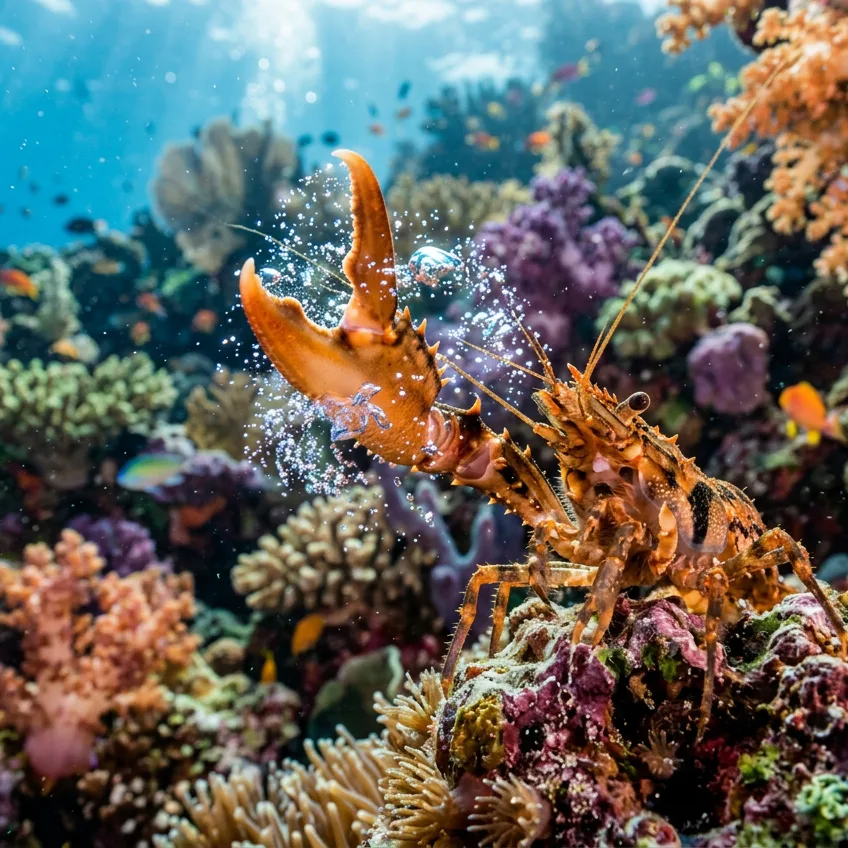
In tropical reefs lives a tiny crustacean barely five centimeters long capable of generating one of the most devastating forces in the animal kingdom: the pistol shrimp (family Alpheidae). Far from biting or striking its prey directly, this animal uses a weapon based on extreme hydrodynamics through an oversized claw.
The claw does not act like a conventional pincer, but rather like a spring-loaded hammer. Upon releasing the built-up tension, a plunger plunges into a hollow cavity at more than 100 km/h in less than a millisecond. This ejection expels an ultrafast water jet that causes a sharp local pressure drop, creating a cavitation bubble.
The amazing part happens when this bubble collapses in on itself:
- Devastating acoustic wave: The implosion produces a crack of up to 218 decibels, an underwater detonation louder than a gunshot that instantly stuns or kills fish and crabs.
- Fleeting stellar heat: During violent compression, trapped gases briefly reach temperatures estimated at 4,700 °C (close to the surface of the Sun), accompanied by a tiny flash of light known as sonoluminescence.
The collective power of these animals is so massive that, during World War II, the US Navy had to train its sonar operators to distinguish the noise of snapping shrimp colonies from the actual sound of enemy submarines.
Source: Detlef Lohse et al., 'Snapping shrimp make flash of light' (Nature, 2001) / Science Magazine.