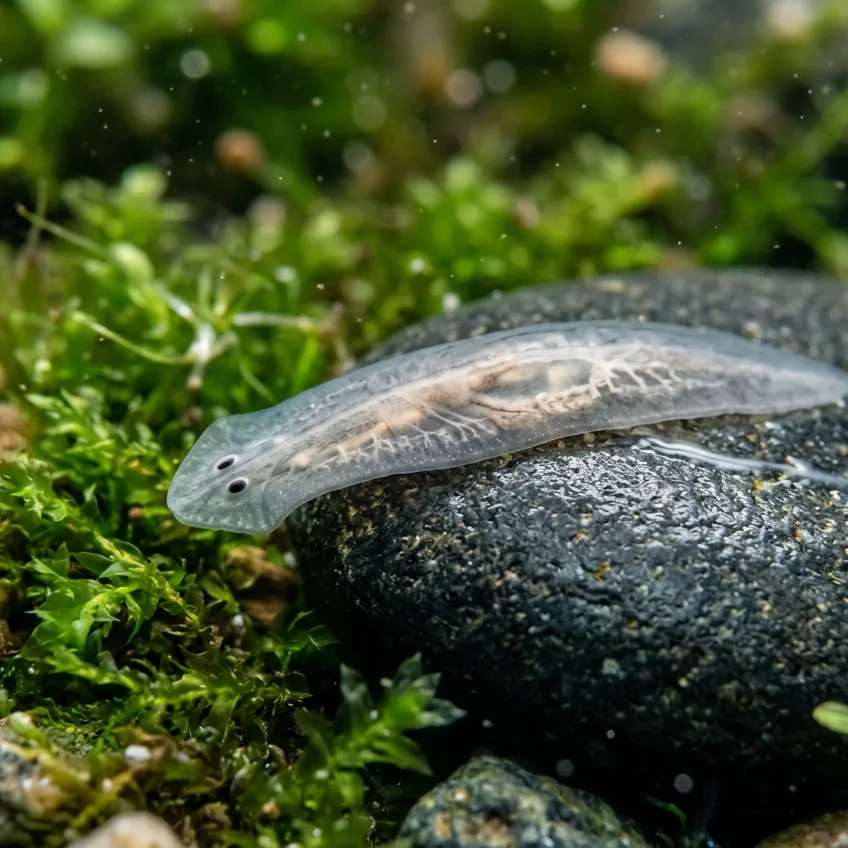
If you cut a planarian into multiple pieces, not only does it not die, but each section will give rise to a complete, independent organism. This tiny freshwater flatworm boasts one of the most astonishing regenerative capacities on the planet, capable of reconstituting a functional individual from just 1/279th of its original body.
The secret to this feat lies in its neoblasts, a dense pool of pluripotent adult stem cells that make up roughly one-fifth of its entire body. These cells have the unique ability to proliferate and differentiate into any biological tissue: from muscles and intestines to eyes and complex nervous tissue. Furthermore, during asexual reproduction, planarians continuously restore their telomeres through inexhaustible telomerase enzyme activity, avoiding cellular deterioration from senescence and achieving virtual biological immortality.
However, modern science's most baffling finding involves its cognition:
- Reconstructed mind: In various studies at Tufts University, planarians were trained to get used to feeding in lit areas, an environment they usually avoid.
- Cellular inheritance of memory: When the trained worms were decapitated, they regrew a fully functional head and brain in under two weeks. When tested, the decapitated worms retained the familiarity with the lit environment learned by the previous brain.
This phenomenon suggests that learned information can be encoded through epigenetic modifications and stored outside the central nervous system, making the planarian a key piece in unraveling the future of human regenerative medicine.
Source: Journal of Experimental Biology / Tufts University Center for Regenerative and Developmental Biology