In the cosmic vacuum, nothing can exceed the 299,792 kilometers per second at which light travels. However, in 1999, a Harvard University team led by Danish physicist Lene Vestergaard Hau achieved one of the most astonishing experimental feats of modern physics: forcing photons to travel at just 17 meters per second (about 61 kilometers per hour), a speed easily achievable by an amateur cyclist.
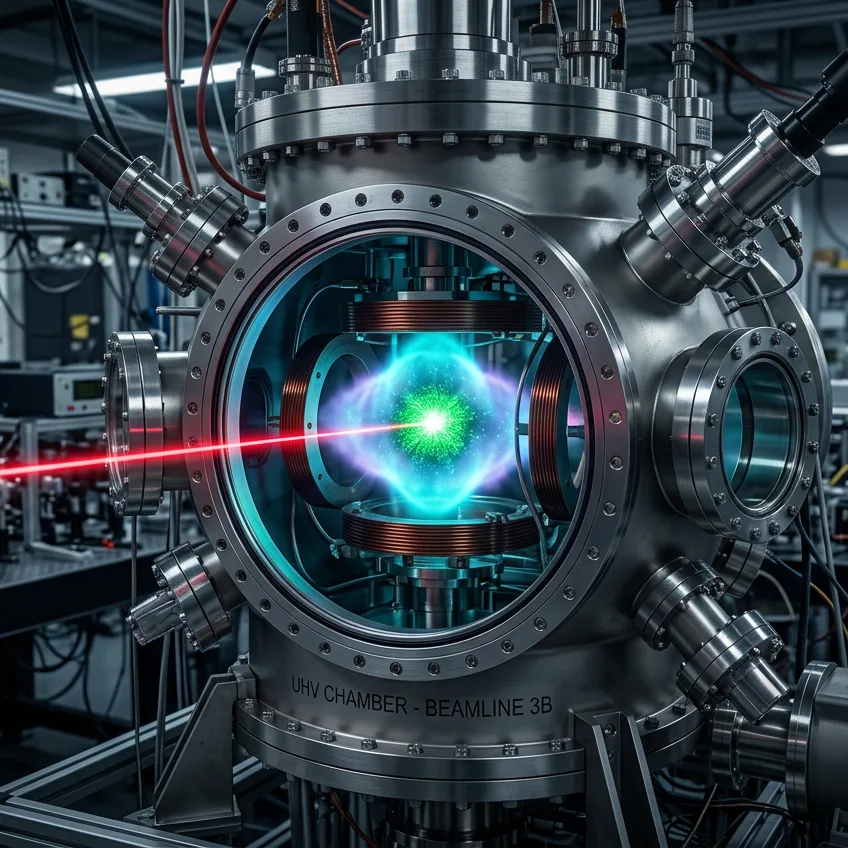
To achieve this colossal deceleration, the team created a Bose-Einstein condensate, an exotic state of matter obtained by cooling a tiny cloud of sodium atoms to barely 50 nanokelvins above absolute zero (-273.15 °C). At that temperature, atoms lose their individual identity and coordinate to behave as a single "giant quantum wave."
The secret lay in a phenomenon known as electromagnetically induced transparency:
- Coupling laser: A first beam of light illuminated the gas cloud, rendering it transparent and drastically altering its refractive index for specific frequencies.
- Compressed pulse: When a second probe laser was sent through this quantum medium, photons became entangled with the electronic states of sodium, reducing their group velocity and compressing a one-kilometer-long beam of light into a space of barely 50 micrometers.
Barely two years later, in 2001, the laboratory took an even more radical step: they managed to stop light completely inside the atomic cloud for milliseconds, storing its information before reactivating it intact.
Source: Nature (Hau, Harris, Dutton & Behroozi, 1999: 'Light speed reduction to 17 metres per second in an ultracold atomic gas')