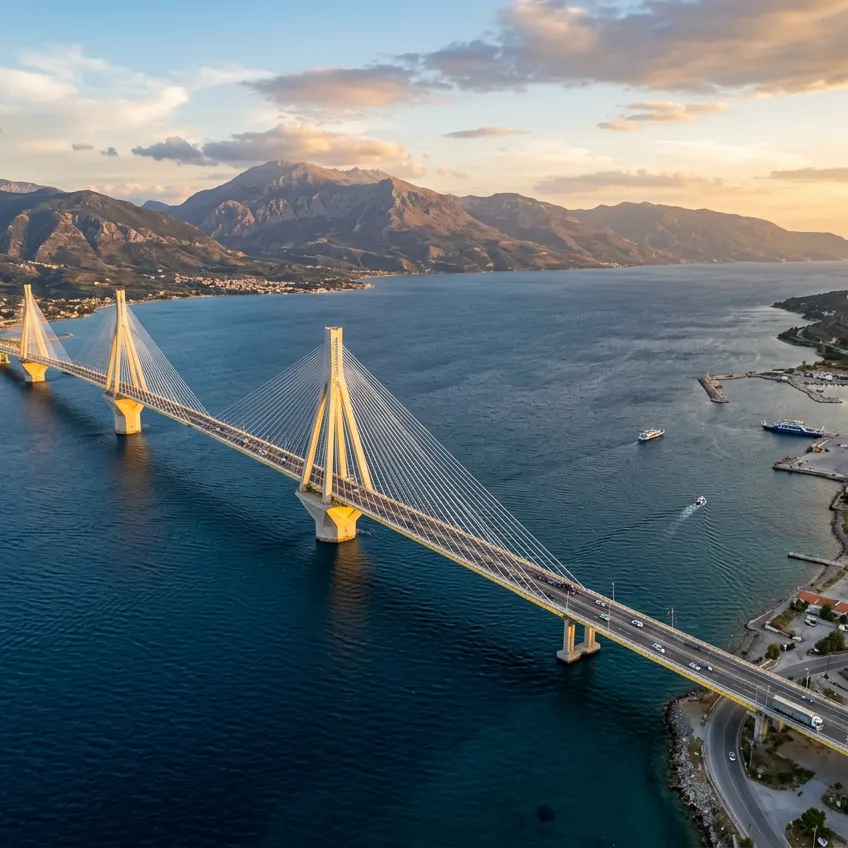
Crossing the Gulf of Corinth to connect the Peloponnese with mainland Greece was considered a technical chimera for over a century. The conditions of the strait brought together the worst combination imaginable for engineering: waters 65 meters deep, a total absence of solid rock beneath the seabed (only mud and soft sediments), and intense seismic activity. In addition, plate tectonics cause both ends of the gulf to naturally pull apart between 25 and 30 millimeters per year.
Inaugurated in 2004, the Rion-Antirion Bridge solved these challenges by defying conventional foundation methods:
- Floating foundations on gravel: Engineers gave up on driving the four gigantic piers into rock. Instead, they reinforced the mud with hundreds of hollow steel pipes and placed a uniform base of calibrated gravel on top. The pylons, with bases 90 meters in diameter and weighing 170,000 tons each, simply rest on this bed, allowing them to slide slightly during an earthquake instead of fracturing.
- A continuous suspended deck: The 2,252 meters of cable-stayed roadway form a single continuous piece suspended entirely by cables, without touching the piers. Four colossal 3.5-meter hydraulic dampers act as brakes to dissipate swaying caused by wind or earthquakes of up to magnitude 7.4 on the Richter scale.
- Tolerance to tectonic drift: The structure was designed to absorb up to five meters of horizontal or vertical displacement between coastlines without collapsing during its 120-year design life.
This engineering marvel proved that, against the Earth's most violent forces, ultimate strength does not lie in absolute rigidity, but in the millimetric capacity to yield and dissipate energy.
Source: Structurae: International Database for Civil and Structural Engineering