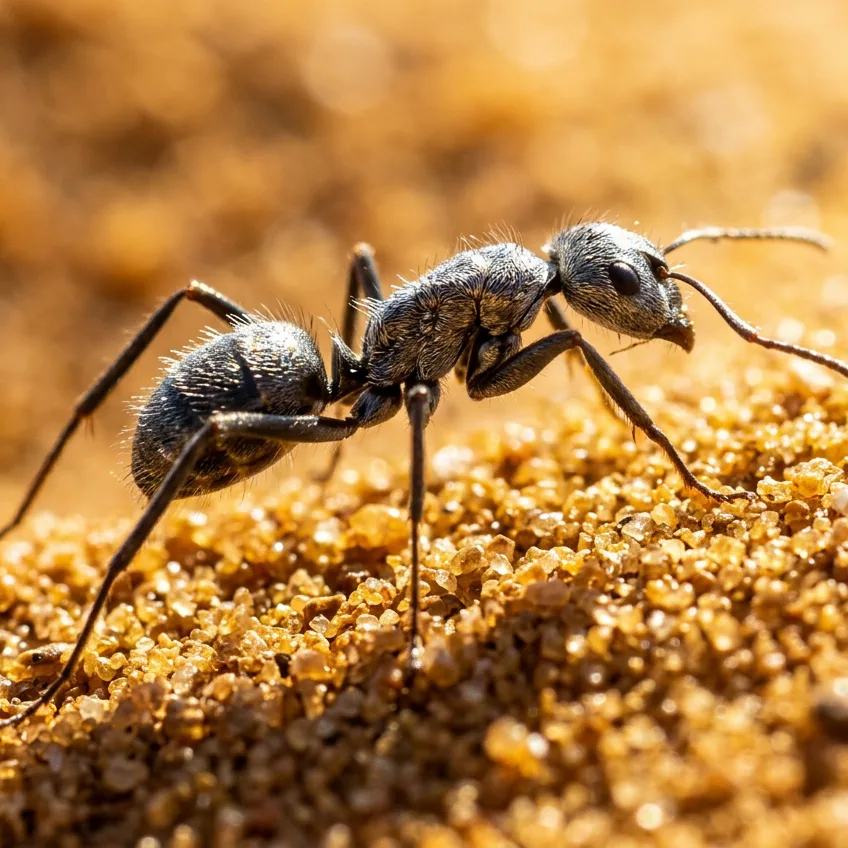
Under the scorching midday sun in the Sahara Desert, where the sand reaches temperatures of up to 70 °C and predatory reptiles flee to seek shelter underground, an extreme survivor emerges: the Saharan silver ant (Cataglyphis bombycina). This insect has a window of barely ten minutes a day to forage for the carcasses of heat-stricken animals before reaching its lethal thermal limit of 53.6 °C.
To avoid dying scorched in this race against time, evolution equipped the ant with an unparalleled optical shield. Researchers from Columbia University and the University of Leuven discovered that its characteristic metallic sheen is a true feat of biological nanotechnology:
- Triangular prismatic hairs: The top and sides of its body are covered with dense hairs featuring a triangular cross section. Their two upper faces reflect visible solar radiation and near-infrared light through total internal reflection.
- Passive radiative cooling: The flat base of the hair acts as a highly efficient emitter in the mid-infrared, radiating the ant's body heat out toward the clear sky.
- Anticipatory heat shock proteins: Unlike almost all living organisms, which synthesize these proteins after experiencing hyperthermia, this insect manufactures them before leaving the nest.
Added to this thermal armor is astonishing speed: it moves at nearly one meter per second (about one hundred times its body length per second), coordinating its six legs with steps so fast that it barely touches the burning ground.
Source: Science (Willot et al., Columbia University / Nanotechnology in Nature)