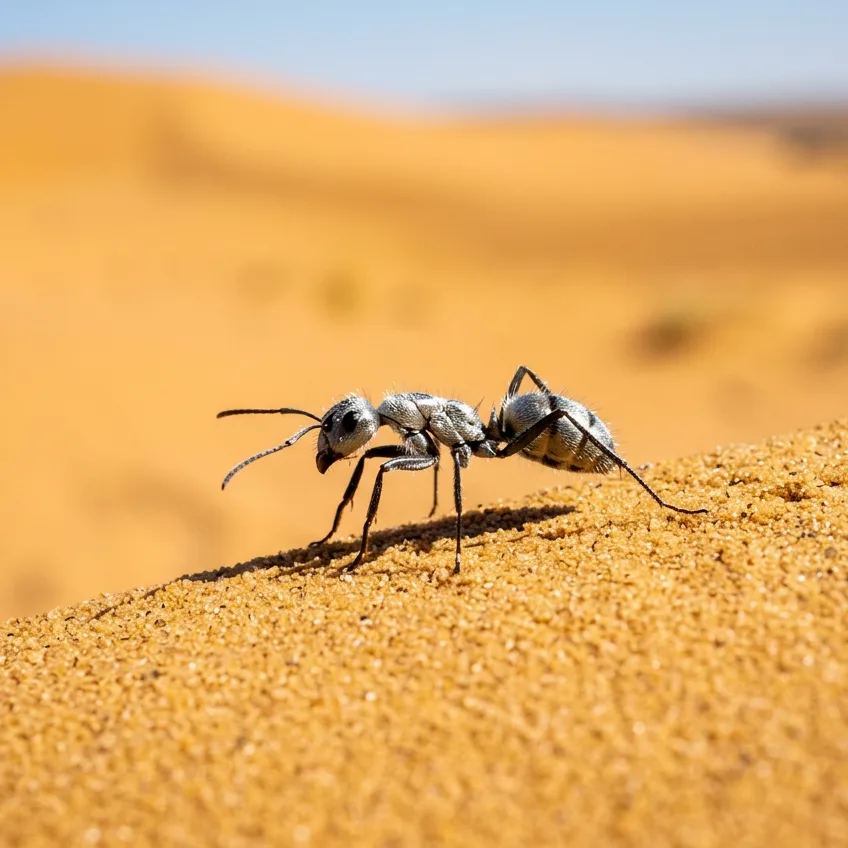
At midday in the Sahara desert, the sand easily exceeds 60 °C, a thermal threshold that forces nearly all animals to take shelter underground. However, it is precisely in this inferno that the Saharan silver ant (Cataglyphis bombycina) emerges to the surface. Its activity window lasts barely ten minutes, the exact amount of time it takes to forage for dead insects before its own predators can bear the heat.
To avoid burning to death, this species has evolved one of nature's most sophisticated biophysical solutions:
- Reflective photonic structures: Its body is densely covered by a layer of hairs with a triangular cross-section. These microscopic filaments act as optical prisms that reflect visible light and near-infrared radiation, giving it its metallic silver shine.
- Passive radiative cooling: In addition to deflecting solar radiation, the hairs enhance the emission of internal heat in the mid-infrared range, dissipating body temperature toward the open sky.
- Extreme speed: It clocks speeds of up to 855 millimeters per second, taking about 50 strides per second. Proportionally to its body size, that equals a human running at more than 500 kilometers per hour.
Thanks to this combination of optical thermoregulation, heat-shock proteins produced before leaving the nest, and extra-long legs that lift it off the boiling sand, the ant can keep its body below its critical thermal maximum of 53.6 °C while hunting on the most hostile ground in the world.
Source: Science (Willot et al., Columbia University / Nanophotonics of Cataglyphis bombycina)