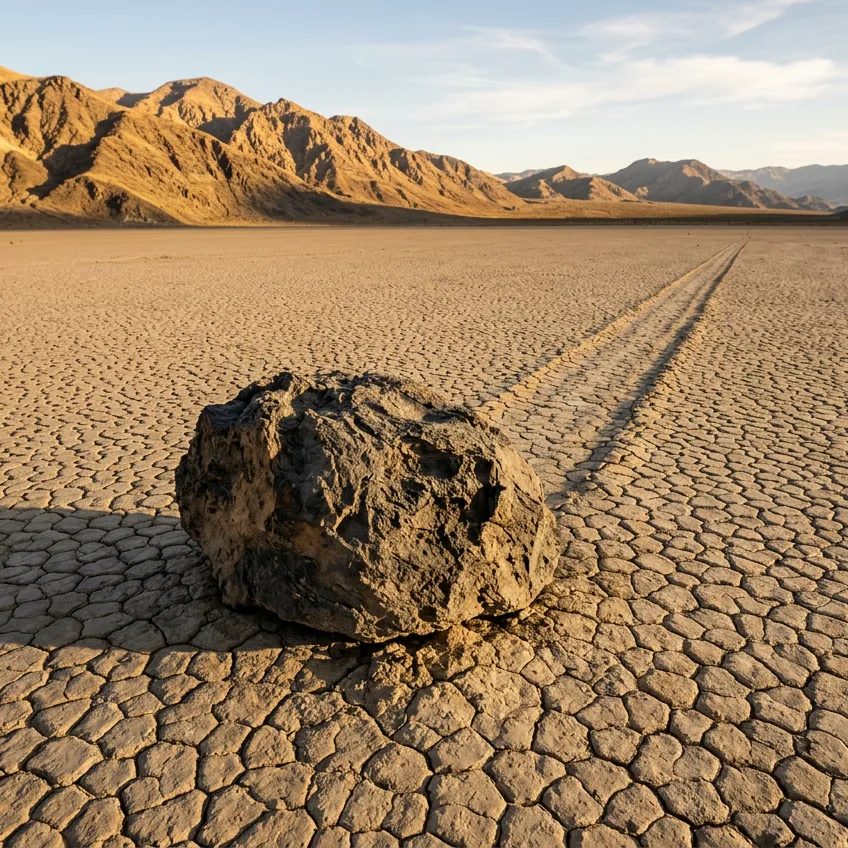
On the dry lake bed of Racetrack Playa, in Death Valley National Park (California), one of the most intriguing geological phenomena on the planet takes place: heavy dolomite and syenite rocks, some weighing over three hundred kilos, move across the plain, leaving behind tracks tens of meters long on the cracked clay.
The mystery, documented since the early 20th century, fueled wild hypotheses about anomalous magnetic fields or impossible hurricane-force winds. However, no one had witnessed their movement live. The definitive answer arrived in 2014, when a team of paleobiologists and geologists led by Richard Norris installed weather stations and high-precision GPS sensors on several experimental rocks.
The engine behind these stones is not an underground force, but an extremely rare meteorological synchrony:
- A thin sheet of water: Scarce winter rains must flood the clay bed to a depth of a few centimeters without completely submerging the stones.
- Windowpane ice: On freezing nights, the water freezes into translucent sheets between three and six millimeters thick, strong enough to float yet thin enough to fracture.
- Gentle winds and morning sun: At dawn, the sun breaks up the ice into large floating rafts that, pushed by moderate breezes of barely fifteen kilometers per hour, exert a gigantic cumulative force on the base of the rocks, slowly dragging them at speeds of two to five meters per minute over the lubricated mud.
When the water evaporates and the mud dries under the sun, the ice vanishes without a trace, immortalizing the trails and creating the optical illusion that the stones came alive on their own.
Source: PLOS ONE (Norris et al., 2014 - 'Sliding Rocks on Racetrack Playa, Death Valley National Park: First Observation of Rocks in Motion')