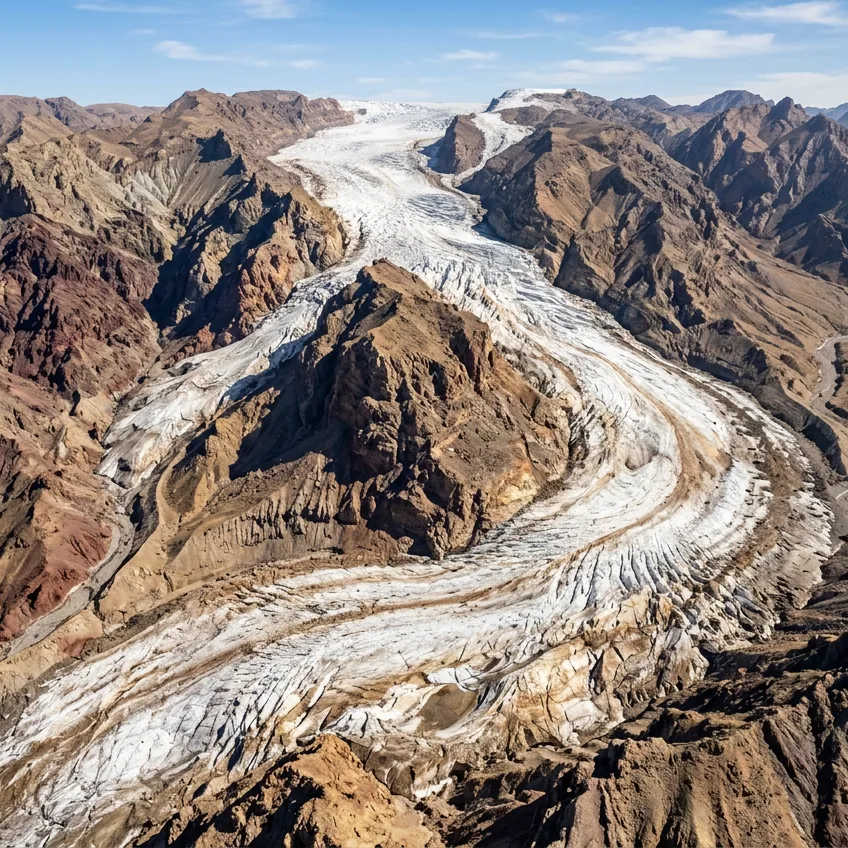
In the Zagros Mountains of southern Iran, Earth's crust hosts one of the strangest geological spectacles on the planet: rock salt glaciers that flow downhill, emulating frozen rivers of ice in the middle of an arid desert.
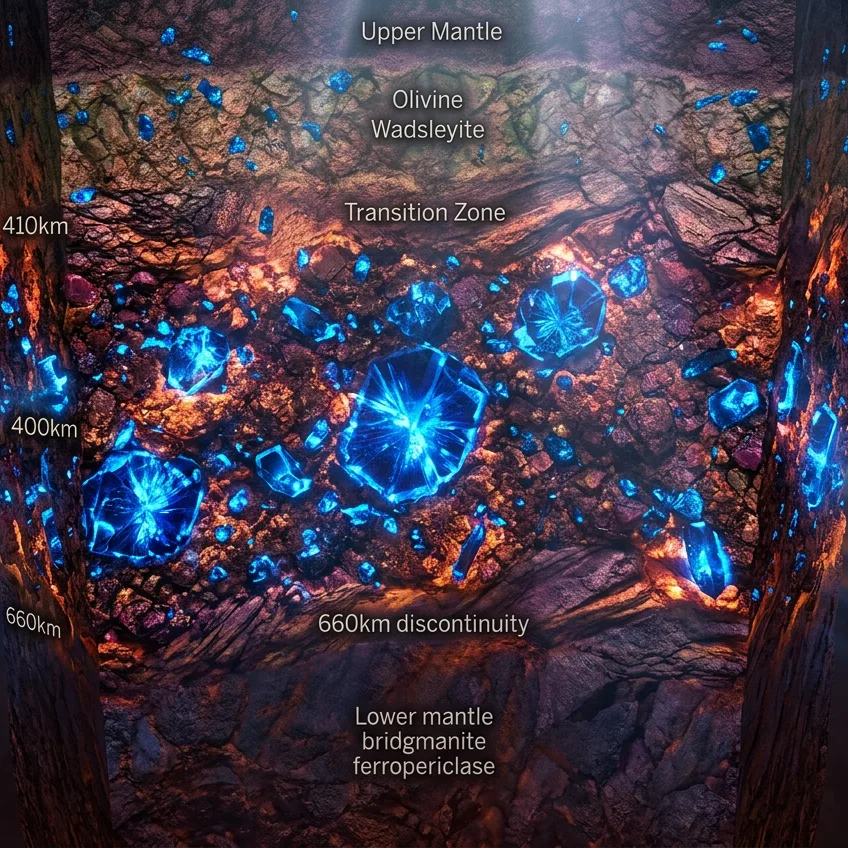
This phenomenon originates thanks to the Hormuz salt formation, an enormous evaporite deposit buried more than 500 million years ago. Because common salt (halite) is significantly less dense than the heavy layers of limestone and sandstone accumulated above it, intense tectonic compression caused by the collision between the Arabian and Eurasian plates created a critical buoyancy imbalance.
Unable to support the weight of the overlying rocks, the underground salt responds by behaving like a viscous fluid through a process known as halokinesis. It rises through geological fractures, forming immense diapirs or domes that pierce through kilometers of rock strata until emerging on the surface. Once in the open air and driven by gravity, this colossal salt mass spills through canyons and slopes at speeds that can reach several meters per year.
Technically known as namakiers (from the Persian namak, salt), these mineral torrents create a hypnotic landscape filled with stalagmites, salt karst caves, and streaks of red, ocher, and purple hues caused by iron oxide and clay impurities. They represent one of the rare corners of the world where solid sedimentary rock can be observed flowing plastically in human time.
Source: NASA Earth Observatory / Geological Society of London